

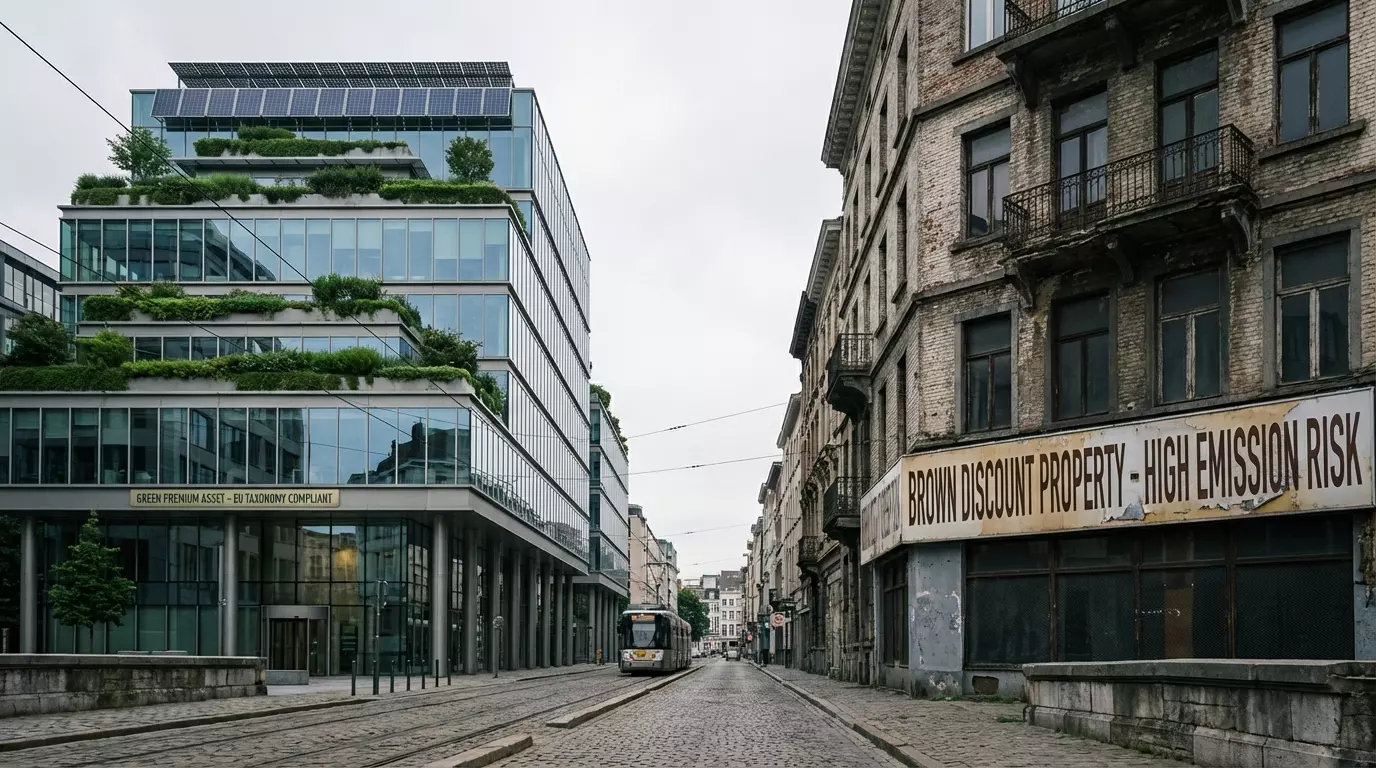
Brown Discounts vs. Green Premiums: Valuation Trends Reshaping European Real Estate in 2026
The European commercial real estate market is experiencing a seismic shift in how buildings are valued, and it all comes down to one thing: energy performance. In 2026, the gap between properties rated EPC A or B and those languishing at F or G has never been wider. Investors, tenants, and lenders are all recalibrating their expectations around sustainability credentials. What was once a “nice to have” green certification is now a hard financial differentiator that determines whether a building commands a premium or suffers a punishing discount. This article breaks down the widening valuation divide, explores the rental implications, and explains why asset obsolescence is no longer a theoretical risk but a present-day financial reality for property owners across Europe.
Green Premiums Are Driving Record Prices in 2026
Buildings with top-tier energy performance certificates are attracting unprecedented buyer interest across major European markets. According to research from MSCI Real Assets, properties rated EPC A or B in cities like Amsterdam, Paris, Munich, and London are trading at premiums of 10% to 25% compared to average-rated stock. This green premium reflects a convergence of factors: institutional investors chasing ESG mandates, tenants demanding lower operating costs, and regulatory frameworks that increasingly penalize inefficient buildings. In the first half of 2026, green-certified office buildings in core European locations saw cap rate compression of 20 to 40 basis points relative to their non-certified counterparts.
The premium is not limited to trophy assets in gateway cities. Even secondary markets are showing clear pricing differentiation based on energy ratings. For example:
- Office buildings with BREEAM Excellent or Outstanding ratings in cities like Dublin and Stockholm are seeing 12% to 18% price premiums over comparable non-certified stock.
- Logistics assets with EPC A ratings in the Netherlands and Germany are trading at yields 30 basis points tighter than older, less efficient warehouses.
- Residential multifamily portfolios with high energy ratings in Scandinavia command valuations roughly 15% above market averages.
What makes 2026 different from prior years is the speed at which the premium is accelerating. Green credentials have moved from a marginal consideration to a primary value driver in underwriting models, and buyers are willing to pay significantly more for future-proofed assets.
Why Brown Discounts Hit Harder Than Owners Expected
On the opposite end of the spectrum, owners of poorly rated buildings are facing discounts that many did not anticipate even two years ago. Properties rated EPC F or G, often referred to as “brown” or “stranded” assets, are experiencing valuation markdowns of 15% to 35% in several European markets. The European Commission’s push toward minimum energy performance standards under the revised Energy Performance of Buildings Directive (EPBD) has created a regulatory cliff edge that is forcing owners to either invest heavily in retrofits or accept significantly lower sale prices.
The brown discount is compounding because multiple pressures are hitting simultaneously. Lenders are tightening financing criteria for energy-inefficient buildings, with several major European banks now refusing to provide new loans for assets rated below EPC D. Insurance costs for poorly rated buildings are also rising. Here is how the discount plays out across asset classes:
| Asset Class | EPC Rating | Average Discount (2026) | Key Market |
|---|---|---|---|
| Office | F/G | 25% to 35% | London, Paris |
| Retail | F/G | 15% to 25% | Spain, Italy |
| Industrial | E/F/G | 10% to 20% | Germany, Poland |
| Residential | F/G | 15% to 30% | France, Belgium |
Many owners who delayed retrofit investments hoping regulations would soften are now facing a harsh reality. The cost of upgrading a large commercial building from EPC G to EPC B can range from €200 to €500 per square meter, and the longer owners wait, the more value erosion they face.
The Rental Gap Between EPC A and F Rated Buildings
The valuation divide is mirrored, and in many cases driven, by a growing rental gap between green and brown buildings. Tenants in 2026 are not just expressing preferences for sustainable space; they are backing those preferences with their wallets. Data from JLL shows that EPC A-rated office buildings in major European cities command rental premiums of 8% to 20% over buildings rated EPC C or below. For the worst-performing buildings rated F or G, the rental discount can be even steeper, with some landlords forced to offer rents 15% to 25% below market averages just to attract occupiers.
Corporate tenants are a major force behind this trend. Companies with net-zero commitments, which now include the vast majority of large European corporates, are under pressure to occupy buildings that align with their Scope 3 emissions reporting. This means:
- Multinational corporations are adding minimum EPC requirements to their leasing criteria, often refusing to consider anything below EPC B.
- Technology and professional services firms are willing to pay premium rents for buildings with on-site renewable energy, smart building systems, and verified carbon performance.
- Public sector tenants in countries like France, Germany, and the Netherlands are mandated by government procurement rules to lease only from buildings meeting minimum sustainability thresholds.
The result is a two-speed leasing market. Green buildings enjoy low vacancy rates, often below 3% in prime locations, while brown buildings struggle with vacancy rates exceeding 15% in the same neighborhoods. This occupancy gap directly feeds back into valuations, creating a self-reinforcing cycle of green premium growth and brown discount deepening.
Asset Obsolescence Is Now a Real Financial Threat
Perhaps the most significant development in 2026 is that asset obsolescence has moved from a theoretical risk discussed in sustainability reports to a concrete financial threat visible on balance sheets. The concept is straightforward: buildings that cannot meet current or forthcoming energy performance regulations risk becoming unlettable and, ultimately, unsellable. In the United Kingdom, the Minimum Energy Efficiency Standards (MEES) are set to require all commercial leases to meet EPC B by 2030. In France, the “Décret Tertiaire” mandates progressive energy consumption reductions for commercial buildings. Across the EU, the revised EPBD is pushing member states to establish national renovation roadmaps targeting the worst-performing building stock.
The financial implications are staggering. Industry estimates suggest that approximately 75% to 80% of the buildings that will exist in Europe in 2050 have already been built, and a significant portion of that stock currently falls below the energy performance thresholds that regulations will require within the next five to ten years. For investors holding large portfolios, the risk is not abstract:
- Stranded asset exposure is now a standard metric in institutional real estate risk assessments.
- Green loan and green bond frameworks from organizations like the Loan Market Association increasingly exclude buildings that do not meet minimum energy criteria.
- Portfolio-level write-downs related to brown asset exposure have already been reported by several European REITs in their 2025 and early 2026 financial statements.
- Retrofit capital expenditure requirements are forcing owners to choose between spending hundreds of millions on upgrades or divesting at steep losses.
The owners who acted early, investing in deep energy retrofits, on-site renewables, and smart building technology, are now reaping the rewards through higher rents, lower vacancy, tighter yields, and access to cheaper green financing. Those who delayed are facing a narrowing window to act before regulatory deadlines and market sentiment make their assets effectively worthless.
In Short
The gap between green premiums and brown discounts in European real estate is not narrowing. It is accelerating. In 2026, energy performance ratings have become one of the single most important determinants of property value, rental income, and investment risk. Buildings rated EPC A and B are commanding premiums of 10% to 25% in sale prices and 8% to 20% in rents, while F and G rated assets face discounts of up to 35% and rising vacancy. Asset obsolescence is no longer a distant concern but a present-day financial reality affecting balance sheets, lending decisions, and portfolio strategies across the continent. For property owners, investors, and occupiers alike, the message is clear: energy performance is not just an environmental metric. It is the new bottom line.
Frequently Asked Questions
What is a green premium in real estate?
A green premium refers to the higher price or rent that a property with strong energy performance credentials, such as an EPC A or B rating, commands compared to less efficient buildings in the same market.
What does brown discount mean for property owners?
A brown discount is the reduction in value or rental income that a property suffers due to poor energy performance, typically associated with EPC F or G ratings. This discount reflects higher operating costs, regulatory risk, and reduced tenant demand.
How much more are EPC A rated buildings worth in 2026?
In major European markets in 2026, EPC A rated commercial buildings are trading at premiums of 10% to 25% above average-rated stock, with rental premiums of 8% to 20%.
What is asset obsolescence in commercial real estate?
Asset obsolescence occurs when a building can no longer meet regulatory requirements or tenant expectations for energy performance, making it difficult or impossible to lease or sell at market rates.
Which European countries have the strictest energy performance regulations?
France, the United Kingdom, the Netherlands, and Germany are among the European countries with the most stringent current and forthcoming energy performance requirements for commercial and residential buildings.


Join The Discussion