

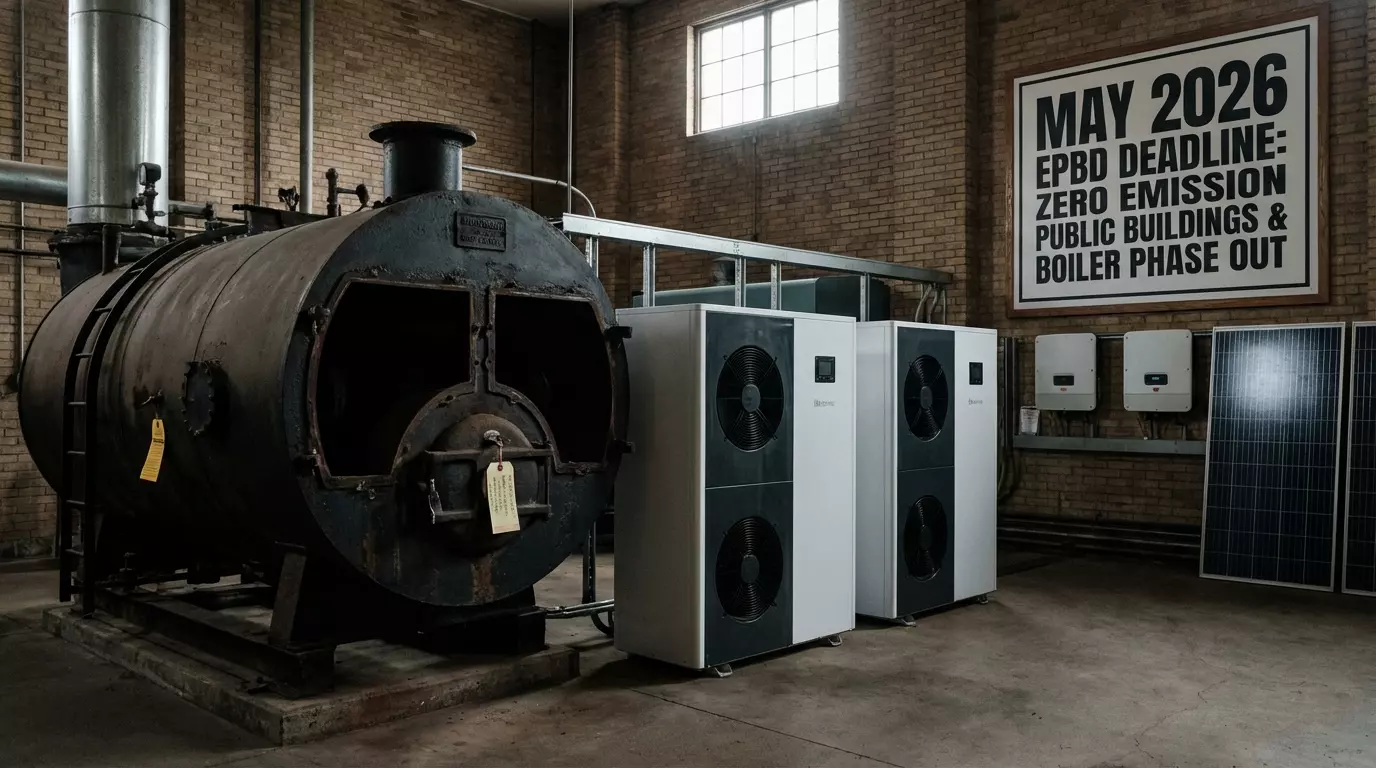
The clock is ticking for property owners across Europe. On May 29, 2026, all EU Member States must have transposed the revised Energy Performance of Buildings Directive (EPBD) into national law. This is not a distant regulatory concept. It is a hard deadline that will reshape how buildings are constructed, renovated, and heated across the European Union.
The European Commission published the recast EPBD in the Official Journal of the EU in May 2024, giving Member States exactly two years to translate its ambitious provisions into binding domestic legislation. For real estate owners, investors, developers, and facility managers, understanding what this directive demands is no longer optional. It is a strategic necessity.
Whether you own a single rental property or manage a large commercial portfolio, the EPBD will directly affect your assets. From mandatory renovation roadmaps to the phasing out of fossil fuel boilers and the introduction of Zero Emission Building standards, the directive touches nearly every aspect of building ownership. This guide breaks down the three most critical pillars of the EPBD and what they mean for you before and after the May 2026 deadline.
EPBD May 2026 Deadline: What Owners Need to Know
The revised EPBD represents the most significant overhaul of EU building energy policy in over a decade. Buildings account for roughly 40% of energy consumption and 36% of greenhouse gas emissions in the European Union, according to data from the European Parliament. The directive aims to make the entire EU building stock zero emission by 2050, with intermediate milestones that begin taking effect almost immediately after transposition.
For real estate owners, the most pressing concern is timing. By May 29, 2026, each Member State must have adopted laws and regulations that comply with the directive. This means that national governments are already in the process of drafting implementing legislation. In practical terms, owners should not wait until 2026 to act. The rules being written today will define compliance requirements for years to come. Key areas of impact include:
- Energy Performance Certificates (EPCs): Harmonized and stricter rating systems across the EU
- Minimum Energy Performance Standards (MEPS): Worst-performing buildings must be upgraded on defined timelines
- Solar energy obligations: New buildings and major renovations may need to incorporate solar installations
- EV charging infrastructure: Pre-cabling and charging points become mandatory in many building types
- Financial planning: Renovation costs will need to be factored into property valuations and investment strategies
Understanding these requirements now gives owners a competitive advantage and reduces the risk of costly last-minute compliance scrambles.
National Renovation Plans and Your Property
One of the cornerstones of the revised EPBD is the requirement for each Member State to submit a National Building Renovation Plan. These plans replace the previous Long-Term Renovation Strategies and carry significantly more detail and accountability. Each country must outline a clear pathway to decarbonize its building stock, including specific targets for 2030, 2040, and 2050. The plans must also include financial strategies, technical benchmarks, and policies aimed at tackling energy poverty.
For property owners, the National Renovation Plans are not abstract policy documents. They will directly determine which buildings need to be upgraded, by when, and to what standard. The directive requires that the worst-performing 15% of non-residential buildings be renovated by 2030, with residential buildings following a similar trajectory. If your property falls within the lowest energy performance classes, you can expect mandatory renovation requirements within the next few years. Here is what the plans are expected to address:
- Timelines for achieving minimum energy performance standards by building type
- Financial support mechanisms such as grants, tax incentives, and green loans
- Technical assistance programs for small property owners
- Specific attention to vulnerable households and tenants in energy poverty
- Monitoring and reporting obligations for Member States
Owners should actively monitor the renovation plan being developed in their country. Early engagement with national consultation processes can provide valuable insight into upcoming requirements and available support.
Fossil Fuel Boiler Phase Out Starts Sooner Than You Think
The EPBD sends a clear signal about the future of heating: fossil fuel boilers are on the way out. The directive mandates that Member States phase out subsidies for standalone fossil fuel boilers by 2025. Looking further ahead, the installation of fossil fuel boilers in new buildings and major renovations will be progressively banned, with a complete phase-out targeted by 2040 at the latest. Some Member States, including the Netherlands and Germany, are already implementing national policies that move faster than the EU timeline.
For real estate owners who currently rely on gas or oil boilers, this is a critical planning issue. Replacing a heating system is one of the most expensive building upgrades, and waiting until the last moment will likely mean higher costs, longer wait times for installers, and fewer options. The directive encourages a shift toward heat pumps, district heating, solar thermal systems, and other renewable alternatives. Consider the following comparison when planning your transition:
| Factor | Fossil Fuel Boiler | Heat Pump |
|---|---|---|
| Upfront cost | Lower | Higher (but subsidies available) |
| Operating cost | Rising (carbon pricing) | Lower and more stable |
| Carbon emissions | High | Very low to zero |
| Regulatory risk | Increasing (bans approaching) | Fully compliant |
| Property value impact | Negative over time | Positive and growing |
| Lifespan | 15 to 20 years | 15 to 25 years |
Acting early on boiler replacement not only ensures compliance but can also improve your property’s EPC rating, reduce operating costs, and increase market value. Several EU countries already offer generous subsidies for heat pump installations, and these incentives may tighten as demand increases closer to the deadline.
Zero Emission Building Standards for New Projects
The EPBD introduces the concept of the Zero Emission Building (ZEB) as the new benchmark for construction. Starting from January 1, 2028, all new buildings occupied or owned by public authorities must meet ZEB standards. For all other new buildings, the ZEB requirement kicks in from January 1, 2030. A Zero Emission Building is defined as a building with very high energy performance where the small amount of energy still required is fully covered by renewable sources, either on-site or from the energy grid.
For developers and investors planning new construction projects, this timeline is already influencing design decisions. Projects that break ground in 2026 or 2027 must be designed with 2030 compliance in mind, since construction timelines often span two to three years. The ZEB standard goes beyond the current Nearly Zero Energy Building (NZEB) requirement by demanding actual zero on-site fossil fuel emissions and a significantly reduced total energy demand. Key elements of ZEB compliance include:
- Maximum primary energy use thresholds set by each Member State
- On-site renewable energy generation, typically through rooftop solar panels
- High-performance building envelopes with superior insulation
- Integration of smart building technologies for energy management
- Life-cycle Global Warming Potential (GWP) reporting for new large buildings
- Mandatory EV charging infrastructure pre-installation
The shift to ZEB standards will increase upfront construction costs by an estimated 5% to 10%, according to industry analyses reported by Reuters. However, these costs are typically recovered through lower energy bills, higher rental premiums, and stronger asset valuations over the building’s lifetime. Early adopters who deliver ZEB-compliant projects ahead of the mandate will enjoy a significant competitive advantage in the market.
In Short
The May 29, 2026 EPBD transposition deadline is not just a date on a regulatory calendar. It is the starting point for a fundamental transformation of the European real estate sector. National Building Renovation Plans will define upgrade timelines for existing properties. The fossil fuel boiler phase-out will force heating system replacements across millions of buildings. And Zero Emission Building standards will redefine what it means to construct a new building in the EU.
Property owners who act now, by auditing their portfolios, planning renovations, exploring heat pump alternatives, and designing new projects to ZEB standards, will be best positioned to protect and grow their asset values. Those who wait risk regulatory penalties, stranded assets, and rapidly declining competitiveness. The EPBD is not coming. It is already here.
Frequently Asked Questions
What is the EPBD May 2026 deadline?
By May 29, 2026, all EU Member States must transpose the revised Energy Performance of Buildings Directive into national law, creating binding rules for building energy performance, renovation, and heating systems.
Will I be forced to renovate my property under the EPBD?
If your building falls within the worst-performing energy classes, you will likely face mandatory renovation requirements. Timelines vary by country and building type, but the first deadlines for non-residential buildings start as early as 2030.
When are fossil fuel boilers banned?
Subsidies for standalone fossil fuel boilers must end by 2025. A full phase-out of fossil fuel boiler installations is targeted by 2040, though some countries are moving faster.
What is a Zero Emission Building?
A ZEB is a highly energy-efficient building where remaining energy needs are met entirely by renewable sources. New public buildings must meet this standard by 2028, and all new buildings by 2030.
How does the EPBD affect property values?
Properties with poor energy ratings face declining values due to mandatory upgrades and higher operating costs. Energy-efficient and ZEB-compliant buildings command premium prices and attract stronger tenant demand.



Join The Discussion