
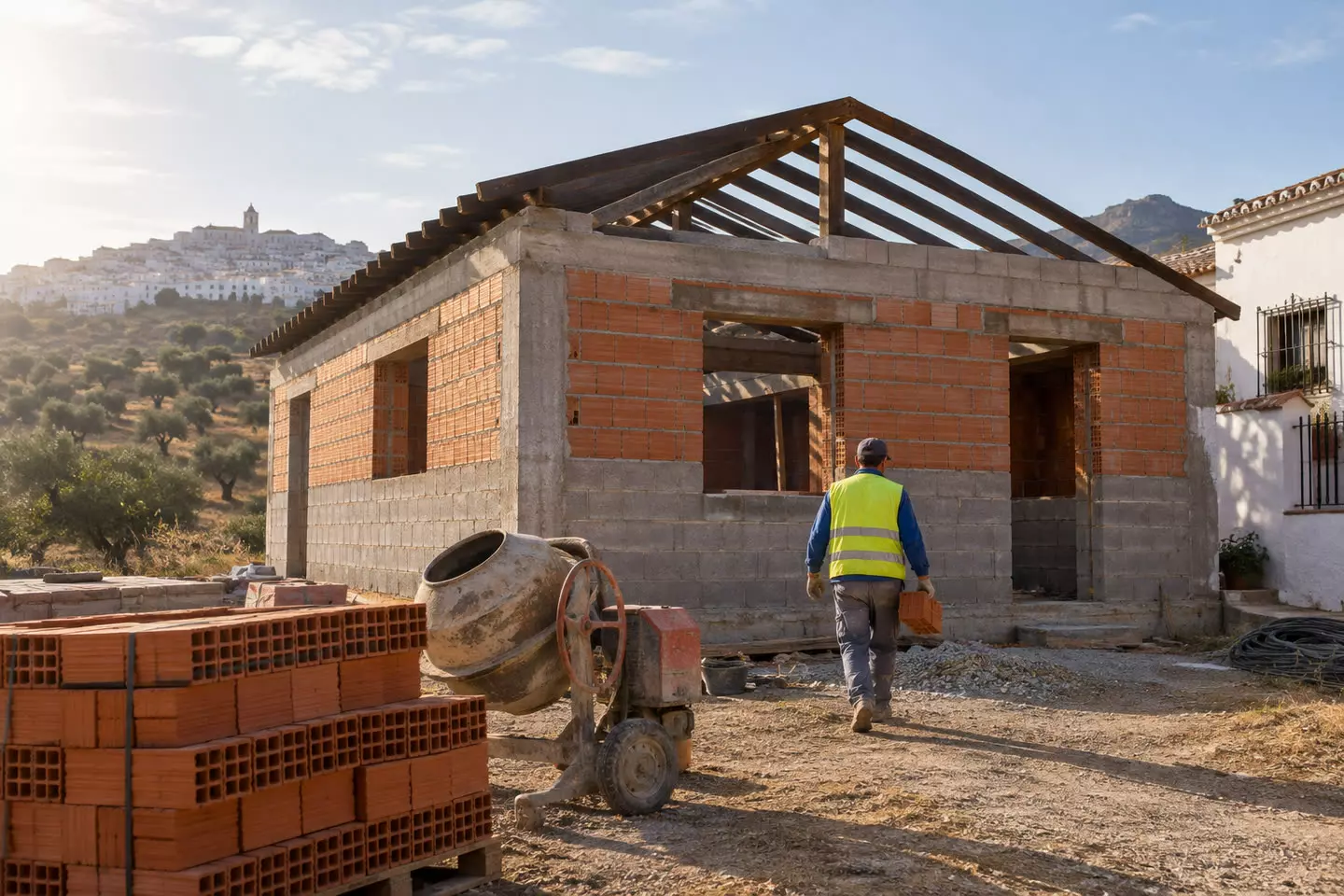
Building your own house in Spain, as an autopromotor, means taking on the role a developer normally plays: buying the plot, appointing the architect, contracting the builder and carrying the risk. idealista/news set out the route on 29 October 2026, and the outline of steps is right. What such guides rarely spell out is how much of the money is fixed by statute rather than negotiated, and that is where a foreign buyer’s budget usually goes wrong.
Three rules decide the arithmetic. The bank releases the mortgage in stages against certified progress instead of handing over a lump sum. The town hall charges two separate taxes on the works, and national law caps one of them at 4%. And the ten-year structural guarantee, which a private self-builder can legally skip, comes back the moment the house is sold inside ten years. None of that is exotic, but all of it sits outside the construction contract that buyers compare first.
How a Self-Build Mortgage Releases Money in Stages
A hipoteca autopromotor pays out in tranches. After each stage the lender’s appraiser checks what has actually been built, and the next instalment is released against that certificate. The money is for the construction and not for the plot, and most lenders cap it at 80% of the lower of two figures: the builder’s budget and the finished property’s valuation. Repayment terms run to 30 years, according to the idealista guide.
Four documents open the file: a plot registered at the Property Registry, an architect’s project carrying the professional association’s visa, a licence application lodged with the town hall and a budget from a builder. The paperwork has to keep moving during the build, because a missing progress certificate stops the next payment and the contractor stops with it. For an agent, that sequence is the practical test of whether a client is ready. A plot that is not registered yet cannot carry the mortgage.
What the Town Hall Charges Before and After the Works
Two municipal charges land around the works, and they are calculated on different bases. Anyone who has compared property tax bills across Europe will recognise the pattern: the base comes from national law and the rate from the town hall. The licence fee follows each town hall’s own ordinance. The Impuesto sobre Construcciones, Instalaciones y Obras, known as ICIO, is the larger one, and article 102 of the consolidated local finance law fixes its shape: the base is the real and effective cost of the works, understood as the material execution cost, with VAT, professional fees and the contractor’s profit left out. Each council sets the rate, and the law says it cannot exceed 4%.
ICIO accrues when the works start, even if the licence has not been granted yet, which catches owners who assume the tax follows the permit. On the construction side VAT is the friendlier number: article 91 of the VAT law applies 10% to works carried out under a contract signed directly between the promoter and the builder, provided at least 50% of the built floor area is housing. The architect and the technical architect invoice at 21%. One more regional charge follows the deed that declares the new build.
| Charge | Base or rate | Who fixes it |
|---|---|---|
| Planning licence fee | Town hall ordinance | Municipality |
| ICIO | Material execution cost, VAT and fees excluded | Municipality, up to 4% |
| VAT on the building contract | 10% of the works | National VAT law |
| VAT on professional fees | 21% | National VAT law |
| Stamp duty on the new-build deed | Rate set by the region | Autonomous community |
Run the numbers on a material execution cost of 200,000 euros. At the 4% ceiling, ICIO comes to 8,000 euros. The same works carry 20,000 euros of VAT at 10%, and the professional fees carry another 21% on top of their own base. That is 28,000 euros of tax on the works alone, before the licence fee, before stamp duty on the deed and before the plot.
The Ten-Year Guarantee, and the Exemption That Ends It
Spanish law puts three guarantee periods on a new house, and article 19 of the Building Regulation Act sets them out: one year for finishes, three years for construction elements and installations that affect habitability, and ten years for the structure, meaning foundations, supports, beams, slabs and load-bearing walls. The minimum insured capital climbs with the period, from 5% of the final material execution cost, professional fees included, for the first year to 30% for the second and 100% for the ten-year cover.
The one-year cover has an alternative worth knowing: the promoter can keep back 5% of the material execution cost instead of insuring it. The ten-year policy, the seguro decenal, is not compulsory for the individual self-builder of a single-family home for their own use. Sell that house within ten years and the exemption ends, because the seller then owes the policy unless the buyer expressly waives it before a notary. Banks often demand it anyway as a condition of the mortgage, so the exemption is a legal fact rather than a saving.
What Has to Be Registered Before Anyone Moves In
Completion is not occupation. The final works certificate signed by the technical team closes the build, and the libro del edificio collects the documentation and the maintenance instructions. What the town hall wants next depends on the municipality:
- a first occupancy licence or an accepted responsible declaration;
- a habitability certificate, in the autonomous communities that still require one;
- the deed declaring the new build, signed before a notary;
- the Property Registry entry, then the cadastral registration;
- the water and electricity contracts in the owner’s name.
Skipping a step on that list is not a technicality. Without the registered deed the house cannot be mortgaged or sold cleanly, and a buyer’s notary will find the gap. For an agent, the sequence is a checklist to run before a client offers on a plot, not after the roof goes on.
What an Agent Should Ask Before the Plot Is Bought
Five checks settle most of the risk before money moves, and they cost a morning each:
- Read the plot’s planning classification and the ordinance that applies to it. A plot described as building land in an advert and a plot the town hall will license are two different things, and the gap is where deposits disappear.
- Match the registry description to the cadastral reference and to what stands on the ground. A surface that differs from the deed is a boundary problem, and it surfaces at the worst moment.
- Ask which route the licence takes in that municipality, a full planning licence or a responsible declaration, and what the town hall’s current processing time is. The build cannot start before it, and neither can the mortgage payout.
- Establish who carries the seguro decenal and whether the lender requires it. That single answer changes the budget and the resale position inside ten years.
- Keep a contingency in the budget. Materials and site problems move the final figure, and the statutory charges are calculated on what is actually spent rather than on the estimate.
Where a Spanish Self-Build Budget Usually Breaks
The break is rarely in the construction contract, which is the number every buyer negotiates hardest. It sits in the charges around it: ICIO on the material execution cost, the two VAT rates, stamp duty on the deed, the licence, the policy when the bank insists on it, and the interest paid while the tranches are drawn. Add the months a licence can take and the contingency stops looking generous.
For an agent selling Spanish property to a foreign buyer, the useful move is to put those numbers beside the plot price before the reservation, while the client can still walk away. The rules described here are the ones in force at the end of October 2026, and the regional and municipal detail is where any single case will differ.
Questions Buyers Ask About Building in Spain
Do I need the ten-year guarantee to build?
Not if you are an individual building one single-family home for your own use, because the Building Regulation Act exempts that case. The exemption is personal and it ends on sale inside ten years. Your lender may still require the policy before it releases the mortgage.
How much of the build will a bank finance?
Most lenders work to 80% of the lower of the construction budget and the finished valuation, over a term of up to 30 years. The plot is not covered by that figure, so the land is normally bought with the buyer’s own money or a separate loan.
Which VAT rate applies to the builder’s invoices?
10%, when the contract is signed directly between the promoter and the builder and at least 50% of the built floor area is housing. Architects, technical architects and surveyors invoice at 21%, and that difference is worth checking on every invoice during the build.
When does the construction tax have to be paid?
ICIO accrues when the works begin, whether or not the licence has been issued by then. The base is the material execution cost without VAT, fees or contractor profit, and each town hall sets the rate up to a statutory ceiling of 4%.
What happens if the house is sold inside ten years?
The ten-year guarantee becomes the seller’s obligation, unless the buyer expressly waives it before a notary. A retrospective audit may be requested, and a buyer’s lender will usually ask for the policy, so the exemption is not a permanent advantage.
Sources: Ley 38/1999 de Ordenación de la Edificación, the consolidated local finance law, Ley 37/1992 del IVA, and idealista/news on the self-build route.