
Ireland will charge the owners of derelict buildings 7% of the property’s market value every year, and the bill arrives through Revenue rather than through the local council. The measure sits in section 76 of the Finance (No. 2) Bill 2026, published on Monday 19 October, which creates a new Part 22C in the Taxes Consolidation Act 1997 and runs to 79 sections and some 242 pages.
The rate is not new. The Derelict Sites Act 1990 already lets councils charge a levy of 7% of market value, and there were 2,140 sites on the registers at the end of 2024, as the Department of Housing sets out. What changes is the collection. Revenue takes over, the owner self-assesses, and the debt becomes a charge on the building itself.
What Ireland Charges Owners of Derelict Buildings
The calculation is deliberately plain. Section 653CB gives the amount as B multiplied by C, where B is the market value of the relevant property on the valuation date and C is the rate of 7%. Market value carries the same meaning it has in the Capital Gains Tax Acts, so it is what the property would fetch on the open market, not a council’s estimate or a rates valuation. The land appurtenant to the building is taxed with it.
A derelict cottage valued at 300,000 euro therefore carries a bill of 21,000 euro a year, fixed until the next revaluation. Section 653CB sets the valuation date at the liability date in the first year and then 1 March after each three-year period, so a rise or a fall in local values in between changes nothing.
| Market value | Annual tax at 7% | Cost over three years |
|---|---|---|
| 150,000 euro | 10,500 euro | 31,500 euro |
| 250,000 euro | 17,500 euro | 52,500 euro |
| 300,000 euro | 21,000 euro | 63,000 euro |
| 450,000 euro | 31,500 euro | 94,500 euro |
The charge is annual and it is self-assessed, which is where owners get caught. If the valuation in the return is well below what Revenue later establishes, a surcharge applies on a sliding scale.
- Stated value under 40% of the ascertained value: 30% surcharge.
- Between 40% and 50%: 20% surcharge.
- Between 50% and 67%: 10% surcharge.
Late filing adds its own penalty, 5% of the tax up to 12,695 euro if the return arrives within two months of the deadline and 10% up to 63,485 euro after that. Interest runs on top, and unpaid tax and interest remain a charge on the property until they are cleared.
Which Buildings Fall Inside the 7% Tax Net
The tax does not catch vacancy as such. Section 653BQ asks whether a building is in use as, and suitable for use as, a dwelling, a business or trade premises, social or community infrastructure, transport, energy, telecoms, water, waste or recreational facilities. A sound house that has stood empty for years is not a derelict property under this test. A house whose roof has gone is.
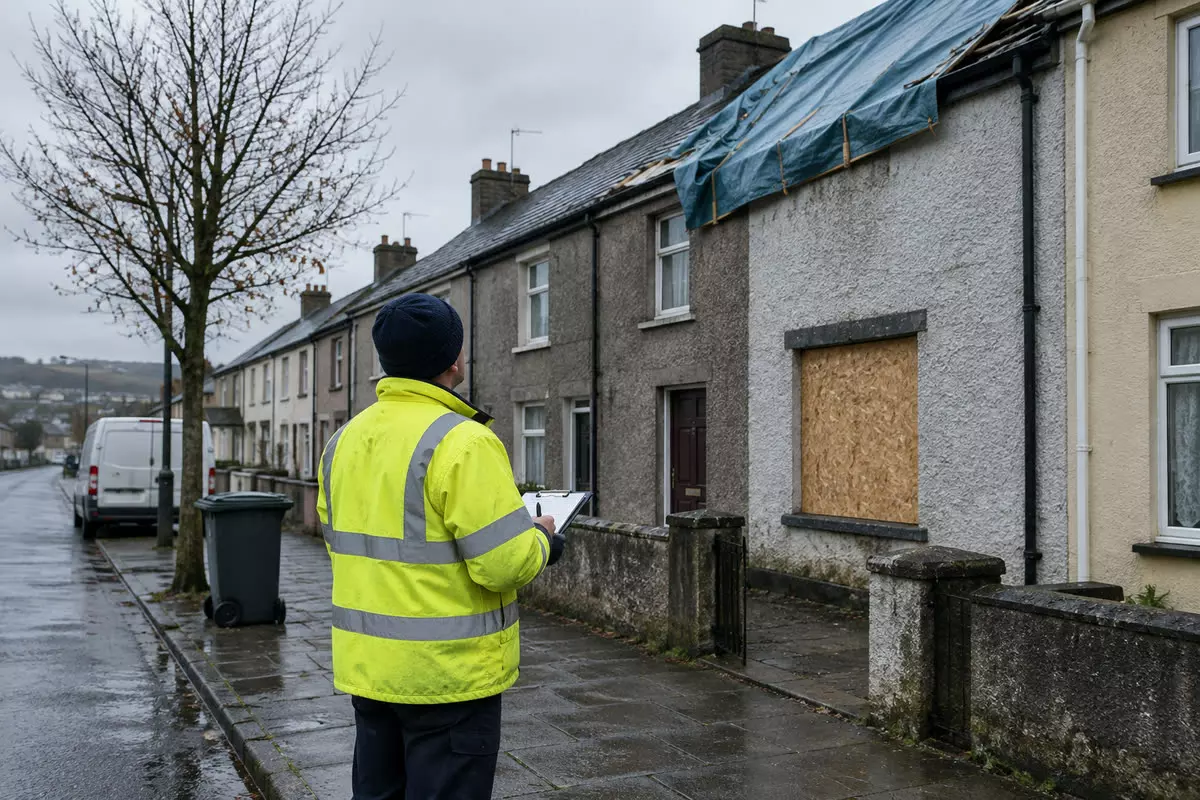
The Bill lists the physical signs a deciding officer in the local authority can rely on, and they are the ones a surveyor would photograph.
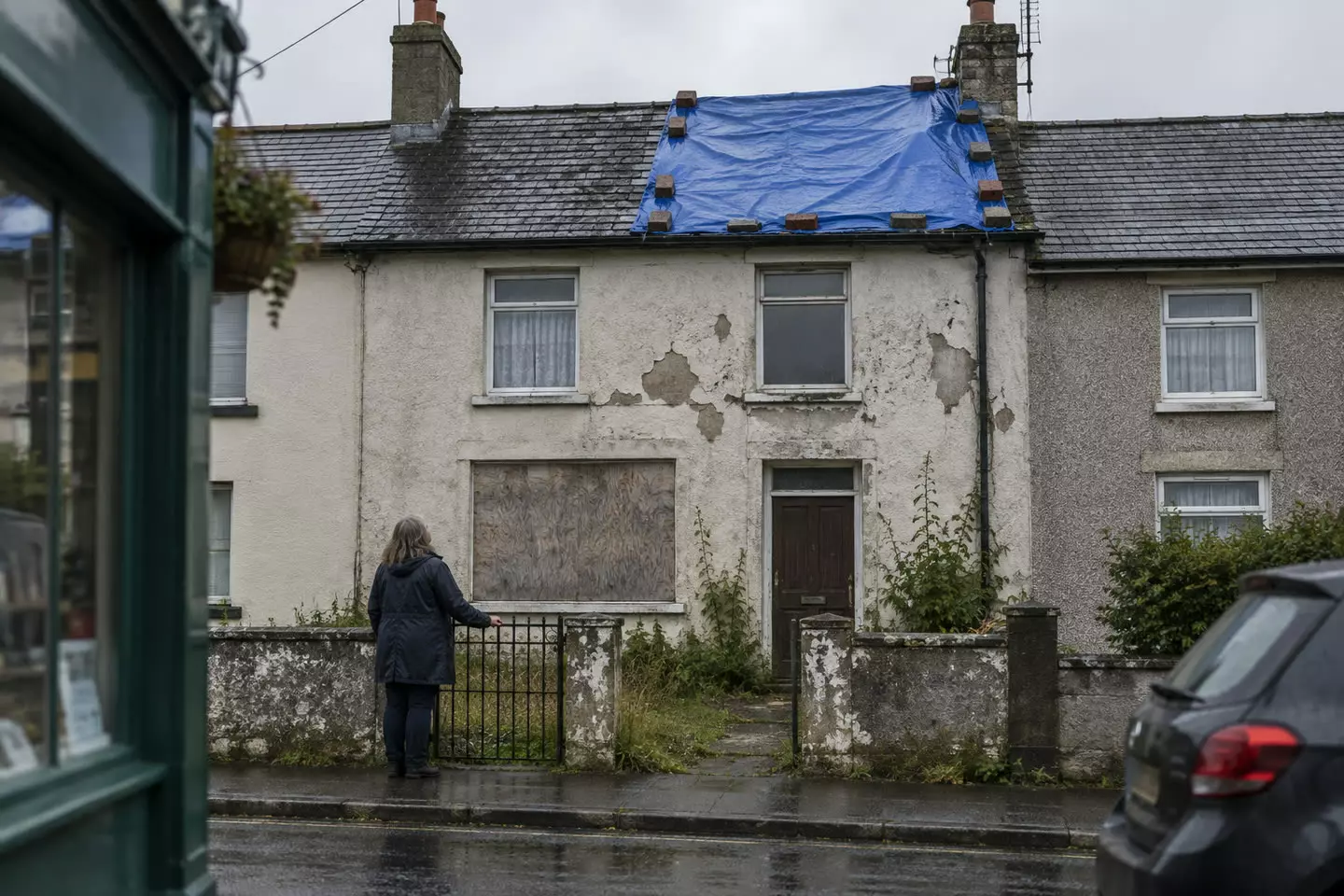
- The property is boarded or blocked up, partly or fully.
- There is no permanent roof, or the roofing material has fallen in or is damaged enough to let the weather in or drop material on the street.
- An elevation has been lost, wholly or in part.
- The building is no longer weatherproof, with rain coming into the interior.
- Render is failing or brickwork is unsecure on any facade.
Several things are outside the charge. National monuments and registered historic monuments are excluded. So is a building under substantial construction works at the time of inspection, provided it has not already been on a register. A property whose owner has a confirmation of completion of remediation works issued at least 28 days before the register is published also stays off it, and so does one covered by the defective concrete blocks scheme.
Geography decides the rest. For the register published in 2027, the tax applies to built-up areas with a population of 4,000 or more. From the 2028 register onwards the threshold drops to 2,000. Built-up area boundaries come from the CSO Urban Areas map of 16 June 2023 held by Tailte Eireann, and population comes from the census, so a village on the edge of a town boundary can move in or out of scope without anyone changing the law.
RTE reported that the first phase covers 107 cities and towns, including Dublin, Cork, Limerick, Galway, Drogheda, Dundalk, Navan, Sligo and Roscommon, with 64 more towns of 2,000 or more added in the second phase for a total of 171 locations. That is the list to check a rural cottage against before quoting a refurbishment budget.
The Dates an Owner Has to Work Back From
The timetable gives owners one full building season between the first public register and the first payment.
- 1 January to 1 March each year: anyone may make a written submission to the local authority on whether a property is derelict, before the register is drawn up.
- 1 September 2027: every local authority publishes its first preliminary register, on its own website and for inspection at its offices. The first one lists buildings in areas of 4,000 or more.
- After publication: the owner appeals inclusion to the local authority. If the works are done, the owner applies for a confirmation of completion of remediation works.
- 28 February 2028: the final register is published. Only properties on the final register are charged.
- 1 March 2028: the liability date. Whoever owns the property that day is the liable person.
- 23 June 2028: the return date, when the tax is paid and the self-assessment filed, electronically.
Payment can be deferred in three situations: after a recent change of ownership, while remediation works are under way, and while an appeal or court proceedings are live. Tax deferred during remediation is not payable at all if the works are finished within the timeframe the legislation specifies and a claim is made. Owners also have to keep books and records for the property, with a penalty where they do not.
What the Tax Means When a Derelict Site Is Sold
This is the part that reaches a buyer. Section 653CJ requires the liable person to pay the derelict property tax and any accrued interest before the sale completes, and to agree and pay any penalty before that date. Revenue then provides either confirmation of the amounts outstanding or confirmation that nothing is owed, in the form and manner it decides.
In practice that makes Revenue clearance part of the closing file on any derelict building, in the way a local property tax certificate already is. Unpaid tax and interest stay a charge on the property, so a buyer who completes without it inherits the problem.
The liable person is the owner on the liability date, drawn wide: the registered owner, a person entitled to the rack rent, or someone holding an interest under which they may carry out remediation works. Co-owners are jointly and severally liable and one of them files a single return. A developer on a long lease with a works agreement can be on the hook alongside the freeholder.

There is a harder edge for abandoned property. Where the owner cannot be identified and the unpaid tax plus interest exceeds the market value of the building, the State may acquire the property if the conditions in the Part are met. That is a slow route, but it means a derelict site with a dead owner is no longer a stalemate.
Dereliction is contagious in a way that shows up in valuations. House prices on a terrace with two or three boarded fronts tend to sit below the town average, and property owners who hold a ruin and wait for a better market are negotiating against their own neighbours as well as against Revenue.
How 7% Compares With Ireland’s Other Property Taxes
Ireland taxes property mostly at the point of transaction. Capital gains tax on a disposal is 31% from 7 October 2026, down from 33%, and it falls on the gain. Stamp duty falls on the price. The derelict property tax is charged on the value whether or not anything is bought or sold, which is the whole point of it and the reason the arithmetic bites.
At 7% a year, an unchanged valuation is matched by tax after roughly 14 years. An owner who does nothing on a 300,000 euro building pays 63,000 euro across the first three-year cycle, and the charge follows the building into any sale. Set that against the cost of a new roof and a rewire and the incentive is obvious, which is what the Department of Finance says the tax is for: bringing derelict stock back into use rather than raising revenue.
It sits alongside the Residential Zoned Land Tax rather than replacing it. The same Bill gives landowners whose land appears on the revised 2027 RZLT map, due on 31 January 2027, another chance to ask the local authority to rezone and, where the conditions are met, to claim an exemption from the 2027 liability. A derelict building on serviced zoned land can face both charges.
For estate agents, the practical advice is short. Property prices in a town with a cluster of boarded fronts carry a discount that outlives the individual sale, so the register is worth reading before a valuation rather than after it. Before valuing a ruin as a project, check whether its town is on the phase one list, whether the building meets the suitability test, and whether the owner has already had a confirmation of completion of works. The 2027 register is public, and a preliminary entry is the moment to appeal rather than the moment to negotiate a discount.
Questions Owners Ask About the Derelict Tax
These are the points that come up first from owners and from buyers looking at a renovation project.
Is an empty house automatically derelict?
No. The test is whether the building is suitable for use as a dwelling, a business or one of the other listed uses, judged on an external inspection. A weathertight house that has stood empty is not caught, while a house with a failed roof and boarded windows is.
When is the first payment actually due?
23 June 2028. The first final register is published on 28 February 2028 and the liability date is 1 March 2028, so the first charge year is 2028 even though councils start inspecting and publishing from 2027.
Does the tax stop once the works start?
It can be deferred while remediation is under way, and tax deferred during that period is not payable if the works are completed within the timeframe and conditions in the legislation and a claim is made. Keep the dates, because the deferral is claimed, not granted automatically.
Can an owner challenge being put on the register?
Yes, in two steps. Inclusion is appealed to the local authority, and a Revenue surcharge can be appealed to the Appeal Commissioners within 30 days of the notice, on the grounds that there were sufficient grounds for the valuation used in the return.