

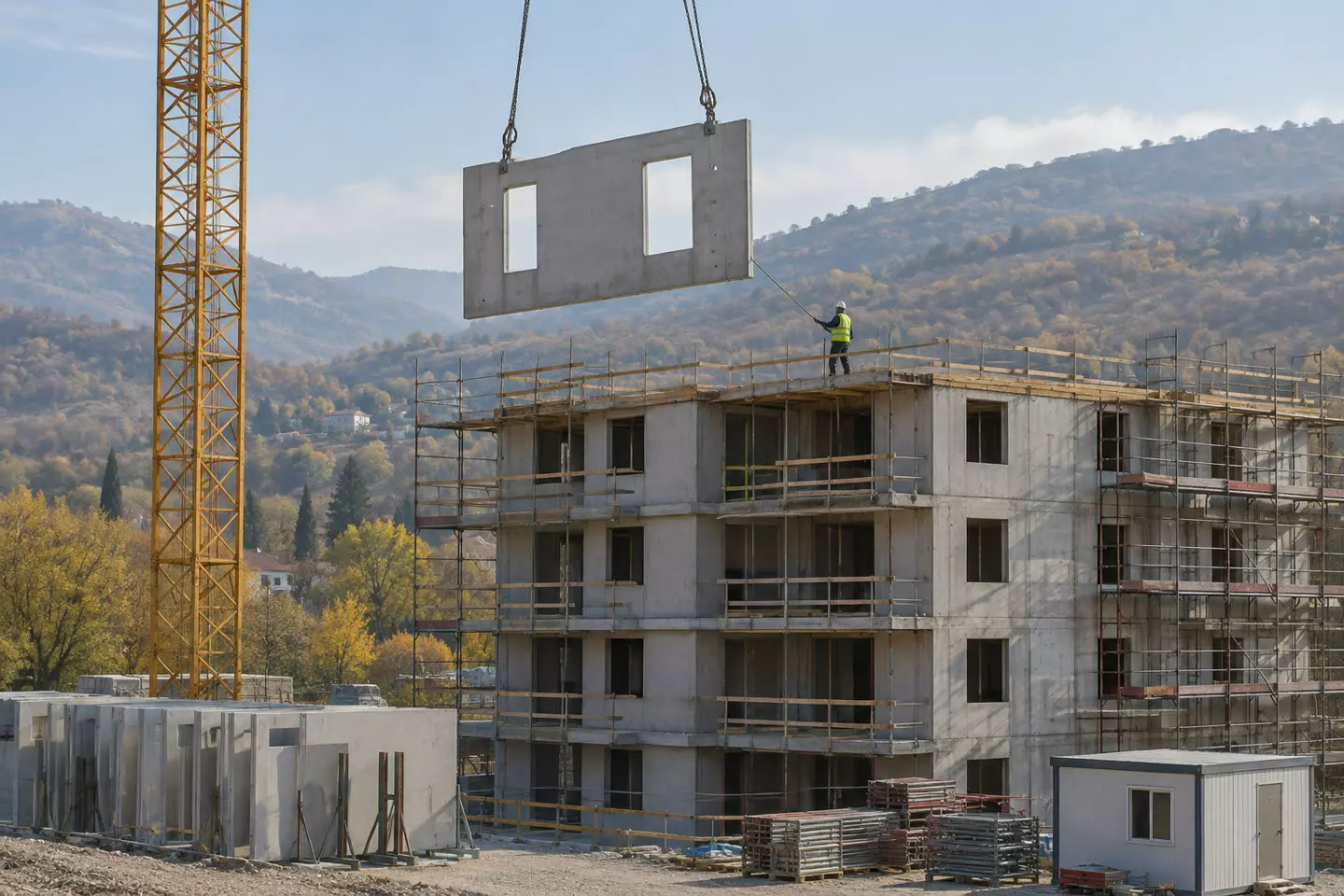
Building work in the euro area is shrinking while the trades that renovate and finish existing homes are growing. Eurostat’s monthly construction output data, updated on 19 October, put the calendar-adjusted index for the construction of buildings at 73.4 in August, down 3.8% from the 76.3 recorded a year earlier, while specialised construction activity rose 3.1% over the same period.
Total construction output still grew, by 1.3% in the euro area and 2.6% across the EU, because civil engineering held flat and specialist trades did the lifting. That split matters more to a buyer than the headline. It says Europe’s building capacity is being absorbed by renovation and infrastructure work rather than by new homes, at a time when the Eurostat series shows the pipeline of new housing getting thinner.
What Eurostat’s August Figures Actually Show
The dataset separates three kinds of work, and only one of them grew in the year to August.
- Construction of buildings: new residential and non-residential structures, which fell 3.8% in the euro area.
- Civil engineering: roads, pipes and networks, which held flat at 97.0 on the calendar-adjusted index.
- Specialised construction: demolition, electrical work, plumbing, plastering, roofing and the trades that renovate an existing home, which rose 3.1%.
Month on month, on seasonally adjusted figures, euro area output rose 1.9% overall. Building work fell 0.4% and civil engineering fell 2.1%, so the entire monthly gain came from specialist trades, which rose 2.6%. Across the EU the same pattern was sharper: building work down 1.0% on July, specialist trades up 2.3%. August is a holiday month in much of southern Europe, which makes the monthly figure noisier than usual and makes the annual comparison the more reliable of the two.
Why Refurbishment Is Carrying the Building Trade
The dataset measures output, not intent, and it does not explain itself. What it can say is that the work being done is smaller in scale and closer to the finished home. A renovation on an occupied or empty flat starts sooner, needs less land and ties up less capital for less time than a residential scheme, which is the shape of work a contractor takes on when finance is expensive and forward sales are slow.
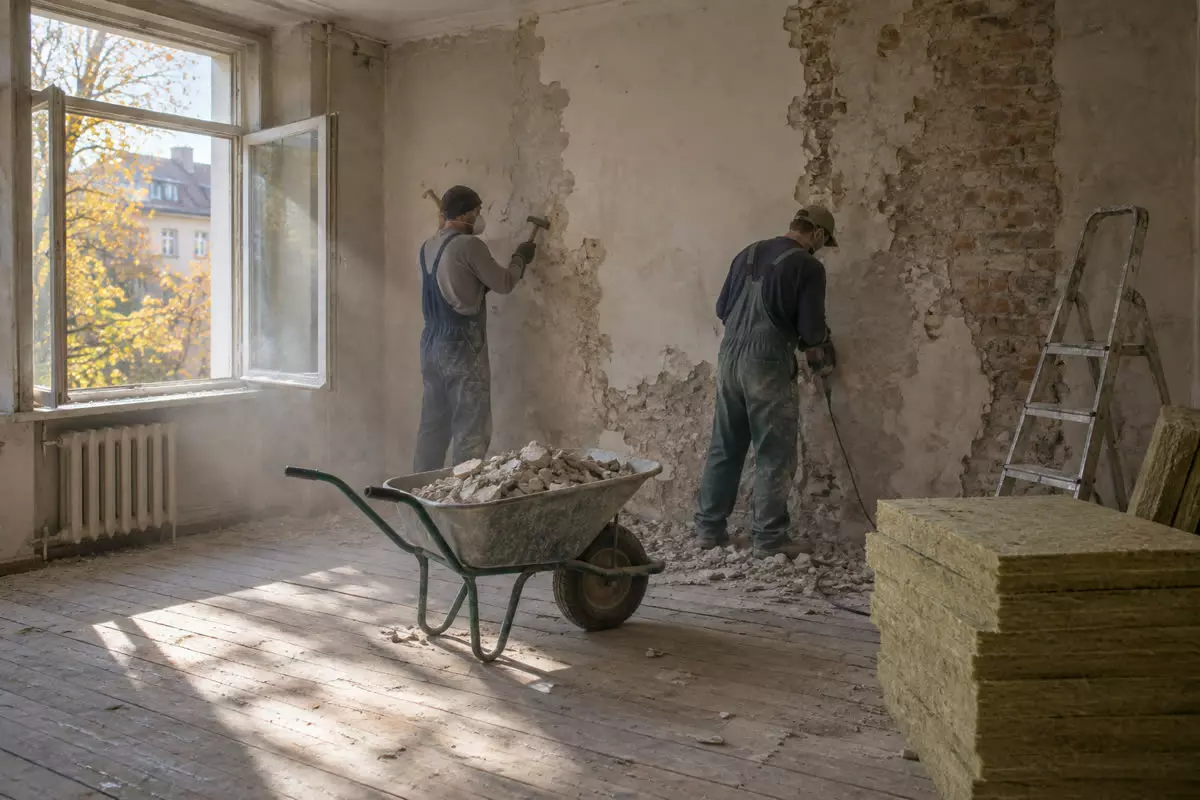
Policy is pushing the same way. The EU’s Energy Performance of Buildings Directive requires member states to plan the renovation of their worst-performing stock, and that obligation lands on owners of older homes rather than on developers. A buyer looking at a resale with a poor energy rating is therefore looking at a property in a market where the labour to fix it is in demand and priced accordingly.
Germany Adds Work While France Cuts Back Sharply
Germany is the outlier on the upside. Its construction output was 10.5% higher in August than a year earlier and 9.3% higher than in July, with specialist trades up 13.4% annually and building work up 2.3%. France is the outlier on the downside, with output down 7.8% on the year and both building work and specialist trades falling at almost the same rate.
Italy sits between the two. Istat reported on 20 October that Italian construction output fell 2.9% in August from July and 3.2% over the June to August quarter, with the calendar-adjusted index 2.2% lower than a year earlier. The same office reported on 9 October that permits for new residential buildings rose 8.0% in the second quarter, which is the tension worth watching: permission is not the same as production.
How the Four Big Markets Compare in August
| Market | Total construction, year on year | Buildings, year on year | Specialised trades, year on year |
|---|---|---|---|
| Euro area | +1.3% | -3.8% | +3.1% |
| EU | +2.6% | -4.1% | +2.9% |
| Germany | +10.5% | +2.3% | +13.4% |
| France | -7.8% | -7.5% | -7.8% |
| Italy | -2.2% | n/a | n/a |
| Portugal | +2.0% | -0.1% | +5.5% |
| Netherlands | -1.4% | -5.5% | +1.9% |
Read the middle column as the supply column. It is the one that decides how many new homes reach a completion certificate in eighteen months, and in August only Germany of the large markets was adding building work. Portugal came within a rounding error of flat, at 103.4 on the index against 103.5 a year earlier, and the Netherlands fell 5.5%.
Read the right-hand column as the renovation column, and note how little it correlates with the middle one. Portugal’s specialist trades grew 5.5% while its building work stood still, and Germany’s grew 13.4% while building work grew 2.3%. France is the exception where both fell together, which is what a stalled market looks like rather than a market shifting from new build to refurbishment.
Eurostat publishes these indices as first estimates and revises them. The absolute levels are less useful than the direction, because the index is set at 100 in 2021 and every country has its own base. What travels across borders is the percentage change, and on that measure the euro area has now spent a year converting building capacity into repair and upgrade work.
What This Means for Buyers and Their Agents
For anyone advising a client this autumn, the data translates into four practical checks.
- On an off-plan purchase, ask for the construction schedule and the penalty clause in the same conversation. Where building work is falling, the contractor’s other sites are the likeliest reason a handover slips, and a fixed completion date without a penalty is a wish.
- On a renovation, get the quote before you sign the purchase deed, not after. Specialist trades are the busiest part of the market, which means the quotes arrive later and hold for less time, and a budget set on last year’s prices will be short.
- Compare a resale with a poor energy rating against a new build on total cost, not on asking price. That is where property prices in the coastal districts have been drifting apart, and where the renovation bill is the variable that decides the better buy.
- In France, treat the weaker numbers as negotiating room rather than as a warning. A market where output is down 7.8% and specialist trades are down with it is a market where the seller’s timetable is softer than the asking price suggests.

Estate agents get asked about house prices and about when a project will be finished, and this release speaks to the second question more directly than to the first. A thinner pipeline of new build supports prices on what is already standing, but it does not create them on its own, because the property market is set by credit, income and supply of existing homes as much as by cranes.
A Thinner Pipeline of New Homes Into 2027
Three things would change this reading. A fall in financing costs would make residential schemes easier to start. A rise in building permits that turns into starts would show up in the buildings index within a quarter or two, as Italy’s permit figures hint they might. And a revision of the August estimates could move the annual figure by a few tenths, though not by enough to remove the gap between building work and renovation.
Until one of those happens, the sensible assumption for a buyer in southern Europe is that the new homes on the market in 2027 were mostly started already, and that the competition for good renovation labour will be stronger next spring than it was this one. That is a planning fact, not a price forecast, and it is the one an agent can act on this week.
Questions Buyers Ask About Building Output
These come up when a client sees a construction statistic for the first time and asks what it means for their purchase.
What did Eurostat publish on 19 October?
Its monthly production in construction figures for August 2026, covering the euro area and each member state. The series is published as an index set at 100 in 2021, split into buildings, civil engineering and specialised construction, and the August release put euro area building work 3.8% below its level a year earlier.
Does falling building output mean house prices will rise?
Not on its own. The index measures work done, not the number of homes sold or the price they fetch, and prices respond to credit, incomes and the stock already on the market. What a thinner pipeline does is limit how much new supply can reach buyers in 2027, which is a support for prices rather than a cause of them.
Why are specialist trades growing while building work falls?
Because the two compete for the same labour and the renovation job is easier to start. A flat that needs rewiring, a bathroom or an energy upgrade can begin as soon as the owner signs, while a residential scheme waits on land, permits and forward sales. The dataset records the result of that choice, not the reasoning behind it.
Which country had the sharpest fall in August?
Of the large markets, France, with total construction output down 7.8% on August 2025 and both building work and specialist trades falling at almost the same rate. Germany moved the other way, up 10.5% on the year, which is the widest gap between the two countries in the current series.
Where can I check the numbers myself?
The full monthly series is public in Eurostat’s database, filterable by country and by type of work, and Istat publishes the Italian release with its own tables on the August 2026 construction page. Both are updated monthly, and both revise earlier months.