

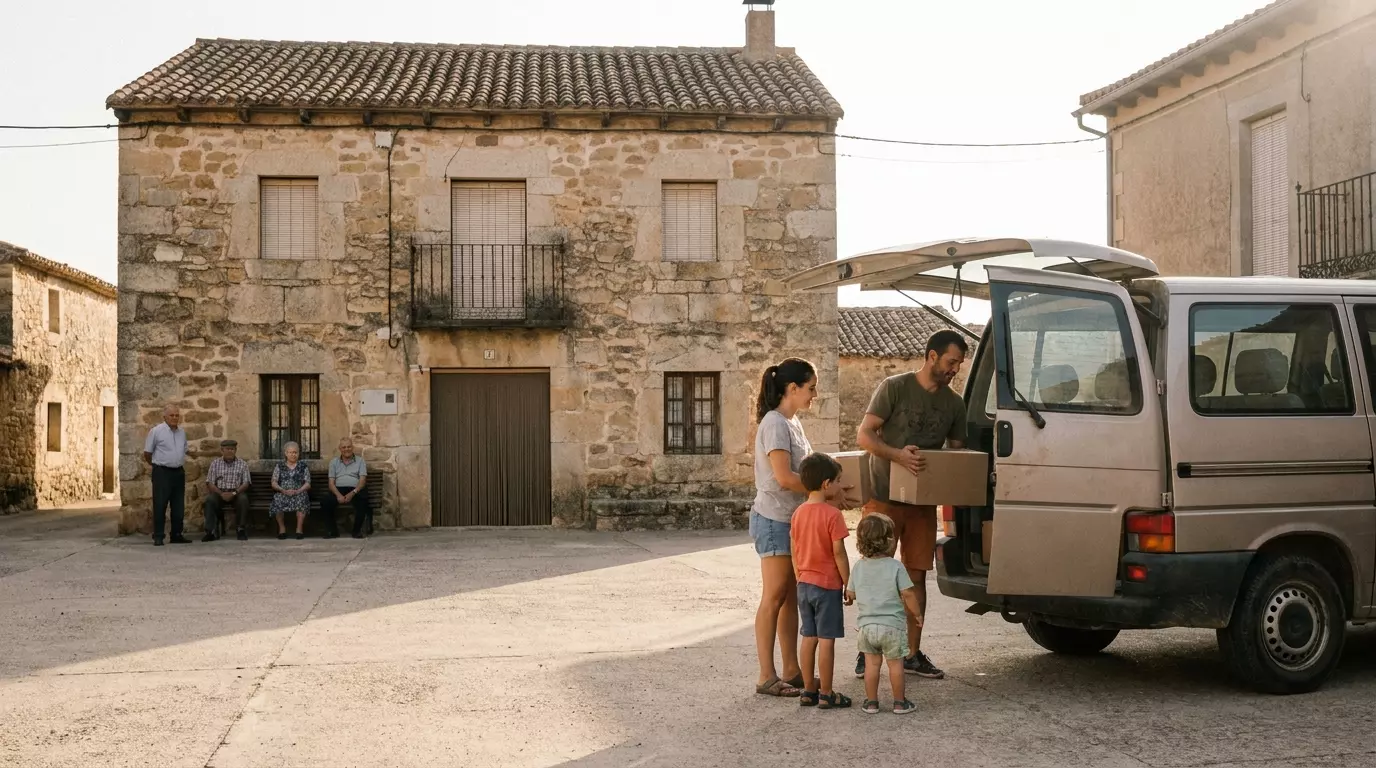
Why Spain’s Emptied Villages Are Giving Homes Away
Spain has a demographic problem that has been building for decades. Roughly 90% of the country’s population is squeezed into about 30% of its territory, leaving vast stretches of the interior nearly empty. This phenomenon, known as España Vaciada (“Emptied Spain”), affects thousands of small municipalities across regions like Castilla y León, Aragón, and Extremadura. Some villages that once housed hundreds of residents now count fewer than fifty, most of them elderly. Schools close, bakeries shutter, and bus routes vanish, creating a downward spiral that accelerates with each departing family.
Faced with the very real prospect of disappearing from the map, local councils have stopped waiting for national solutions and started offering something cities cannot: free or nearly free housing. But this is not charity. It is a calculated survival strategy known as “integrated revitalization,” where housing is exchanged for something the village desperately needs, such as running the local bar, managing the shop, or filling a municipal role. The logic is simple. A family with children means an open school. An open school means other families might stay. One working business means a reason for neighbours to gather. In depopulated Spain, every new resident is infrastructure.
Inside Arenillas: A Rent-Free Deal With Real Strings
The village of Arenillas, in the province of Soria in Castilla y León, has become one of the most cited examples of this model. Soria is among the most sparsely populated provinces in all of Europe, with population densities in some comarcas comparable to Lapland. Arenillas, home to only a few dozen permanent residents, made headlines when its town hall offered rent-free housing to families willing to relocate. The homes were renovated municipal properties, and the offer targeted families with school-age children specifically, because keeping the local education route alive was a top priority for the mayor and council.
The strings attached were clear from the start. Incoming families were expected to take on essential roles the village could not fill on its own. In practice, this meant commitments like operating the village bar and multi-service shop, which often doubles as the social heart of the community, or taking on caretaking and municipal maintenance duties. The arrangement typically included a trial period, after which families demonstrating stable integration and reliable service could stay long term at no rent or a symbolic fee. Arenillas proved that the model can work when expectations are explicit: the village gets services and children, and the family gets housing security and a fresh start away from urban rental prices.
How España Vaciada Programs Actually Work in 2026
By 2026, what began as scattered, improvised offers from desperate mayors has matured into a semi-structured ecosystem. Regional governments, provincial councils (diputaciones), and platforms like Holapueblo, an initiative backed by companies including Ikea and Redeia, now act as matchmakers between villages and would-be rural residents. Programs generally fall into a few recognizable categories, and understanding the differences matters before packing your bags:
- Rent-free housing for municipal roles. The Arenillas model. A family receives a renovated home in exchange for running the bar, shop, or providing caretaking services.
- Symbolic rent schemes. Villages offer homes for 50 to 150 euros per month, conditional on registering as residents (empadronamiento) and enrolling children in local schools.
- Business handover programs. Retiring owners of rural bakeries, bars, or farms transfer their business, often with subsidized or free housing attached, to newcomers who commit to keeping it open.
- Remote worker incentives. Some municipalities offer housing grants or coworking access to teleworkers who commit to multi-year residency, supported by Spain’s national rural broadband rollout.
The financial machinery behind these offers has also grown. Spain’s national government channels funds through demographic challenge programs under the Ministry for the Ecological Transition and the Demographic Challenge, while EU recovery funds have financed housing rehabilitation in villages under 5,000 inhabitants. In 2026, the typical process looks like this: a family applies through the town hall or a platform, undergoes an interview and vetting process, signs an agreement detailing housing conditions and service obligations, and completes a probationary period of six to twelve months. Villages have learned from early failures, when some newcomers left within months, so contracts now commonly include minimum stay clauses of two to five years.
Comparing the Main Program Models
| Model | Housing Cost | Obligation | Typical Commitment |
|---|---|---|---|
| Municipal role exchange | Free | Run bar, shop, or caretaking | 2 to 5 years |
| Symbolic rent | 50 to 150 EUR/month | Residency registration, school enrolment | 1 to 3 years |
| Business handover | Free or subsidized | Keep existing business operating | 3 to 5 years |
| Remote worker incentive | Grant or reduced rent | Verified residency, local spending | 2 to 4 years |
What Families Trade for a Free Roof in Rural Spain
The word “free” deserves scrutiny. Families who accept these deals are trading labour, lifestyle flexibility, and urban convenience for housing security. Running a village bar in a hamlet of 60 people is not a passive gig. It means opening daily, serving as an informal social worker for elderly neighbours, and accepting modest income, since revenue in a tiny village will never rival a city establishment. Successful applicants tend to share certain traits: adaptability, some savings as a cushion, a genuine desire for rural life rather than mere escape from rent, and children, since families with kids are prioritized almost everywhere.
What they receive in return, however, goes beyond the roof. Consider the practical trade-offs:
- Gained: zero or minimal housing costs, guaranteed livelihood role, tight community support, safe environment for children, access to nature, and often startup grants of several thousand euros for taking over a business.
- Given up: urban amenities, career variety, anonymity, and easy access to specialized healthcare, which may require driving 40 minutes or more.
- Risked: social pressure in a community where everyone knows everyone, and contractual penalties if they leave before the agreed term.
Reports covered by outlets like The Guardian have documented both success stories and quiet failures. The families who thrive are usually those who arrived with realistic expectations. Those who imagined a romantic rural idyll with none of the work often departed within a year. For villages, even a 50% retention rate is a victory, because every family that stays reverses, however slightly, a decline that once seemed irreversible.
In Short
Spain’s emptied interior is running one of Europe’s most interesting social experiments. Villages like Arenillas have converted their greatest weakness, empty housing stock, into their strongest recruitment tool, offering rent-free homes to families willing to become the baker, the barkeeper, or the caretaker the community cannot survive without. By 2026, these España Vaciada programs have evolved from desperate improvisation into structured schemes with vetting, contracts, minimum stays, and institutional backing from regional governments, EU funds, and matchmaking platforms like Holapueblo.
The model is not a magic fix for rural depopulation, and it demands real commitment from those who sign up. But it works often enough to matter. For families priced out of Madrid or Barcelona, and for villages one closed school away from extinction, integrated revitalization offers something rare: a deal where both sides genuinely need each other. Free housing in rural Spain is not a giveaway. It is an exchange, and for the right people, it is one of the best deals available anywhere in Europe.
FAQ
What is España Vaciada?
España Vaciada, or “Emptied Spain,” refers to the vast rural interior of the country that has suffered decades of depopulation. It also names the political and social movement demanding investment and services for these areas.
Do I really pay no rent in villages like Arenillas?
In the strictest versions of the model, yes, housing is rent-free. However, you commit to performing an essential role, such as running the village bar or shop, and contracts usually include minimum stay periods of two to five years.
Can foreigners apply to these programs?
Generally yes, provided they have legal residency rights in Spain. EU citizens face few barriers, while non-EU applicants need a valid visa or residence permit. Spanish language skills significantly improve acceptance chances.
Why do villages prioritize families with children?
Children keep the local school open, and an open school is the single strongest factor in attracting and retaining other families. A closed school often marks the beginning of a village’s terminal decline.
What happens if a family leaves before the agreed period?
Most modern agreements include clauses requiring repayment of subsidies or back rent if residents depart early. Villages introduced these terms after early participants left within months, wasting renovation investments.
Are these villages remote from everything?
Many are 30 to 60 minutes from a mid-sized town with hospitals and supermarkets. Broadband coverage has improved substantially thanks to national rural connectivity programs, making remote work increasingly viable.


Join The Discussion