

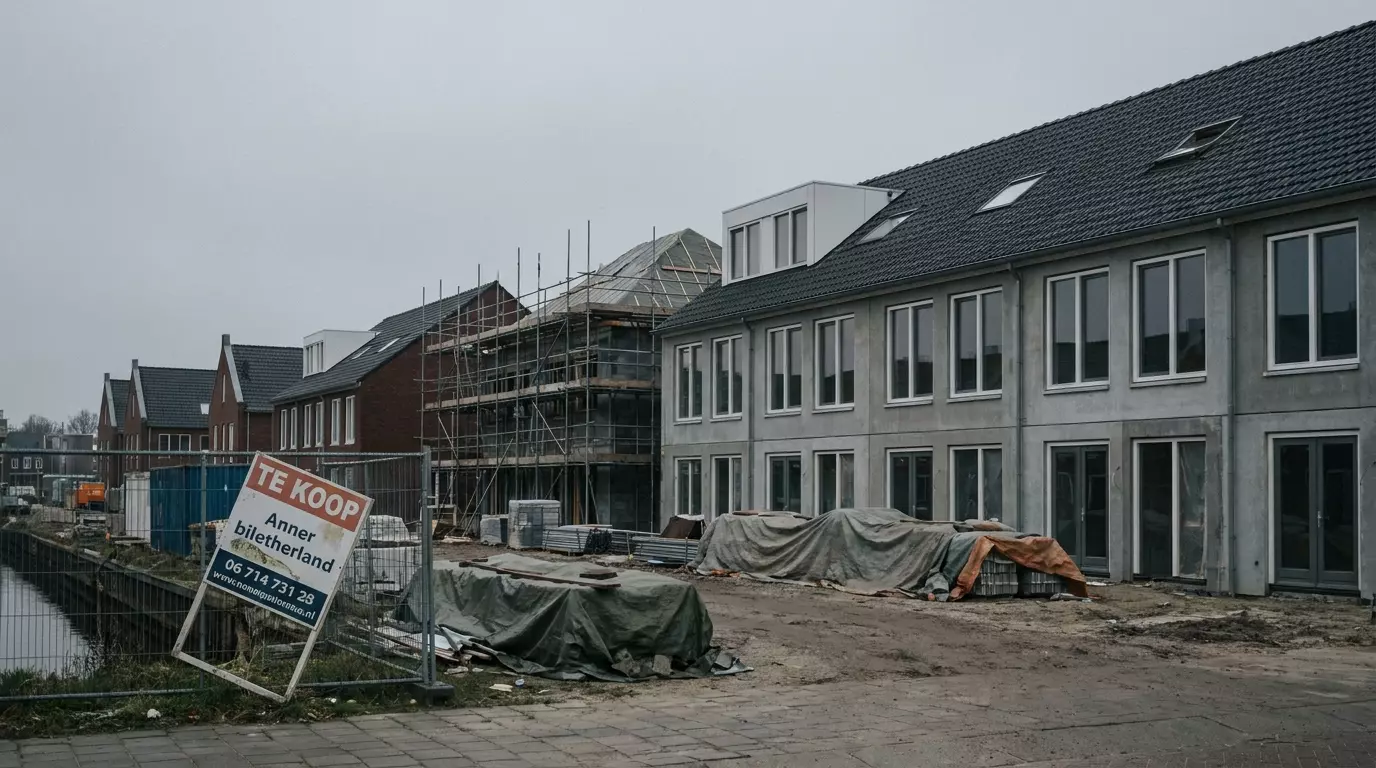
Dutch New Build Housing Market Hits the Brakes: Sales Drop 19 Percent
The Netherlands has long struggled with a housing shortage, and new construction has been positioned as the country’s best route out of the crisis. Yet fresh figures reported by NL Times reveal a worrying trend: sales of new build homes have fallen by 19 percent, signalling a clear cooling of a market segment that policymakers were counting on to deliver hundreds of thousands of homes in the coming years.
This slowdown matters far beyond developers’ balance sheets. With the Dutch government targeting roughly 900,000 new homes by 2030, a sustained dip in new build demand could ripple through construction pipelines, delay projects, and deepen the affordability crunch for first-time buyers. In this article, we break down what is driving the decline, why buyers are hesitating, and what it all means for the future of Dutch housing.
Dutch New Build Home Sales Slide 19 Percent
According to the latest market data, the number of newly constructed homes sold in the Netherlands dropped by 19 percent compared with the same period a year earlier. This is a sharp reversal after a period in which new build transactions had been recovering on the back of falling mortgage rates and pent-up demand. Industry bodies tracking the sector, including real estate association NVM and national statistics office CBS, have both flagged a noticeable loss of momentum in the new construction segment.
The decline stands in contrast to the existing homes market, where transaction volumes and prices have remained comparatively resilient. That divergence tells an important story: buyers are not disappearing from the Dutch housing market altogether, they are simply steering away from new build projects. Several factors explain this shift, and most of them come down to one word: price.
Key figures at a glance:
- New build sales: down 19 percent year on year
- Existing home sales: holding relatively steady
- National target: around 900,000 new homes by 2030
- Main pressure points: high asking prices, construction costs, and limited affordable supply
Why Buyers Are Pulling Back From New Construction
The single biggest deterrent for buyers is the widening price gap between new build homes and existing properties. Newly constructed homes in the Netherlands now command a significant premium, often running tens of thousands of euros above comparable existing houses. For households already stretched by mortgage limits, that premium is increasingly hard to justify, even when factoring in the long-term savings of energy-efficient new homes with heat pumps, solar panels, and superior insulation.
Timing and uncertainty also play a role. Buying a new build usually means purchasing off-plan, waiting one to two years for completion, and carrying double housing costs in the meantime. In a climate of economic caution, many buyers prefer the certainty of an existing home they can move into immediately. Add in stricter mortgage lending rules and lingering worries about construction delays, and the reluctance becomes easy to understand.
| Factor | New Build Homes | Existing Homes |
|---|---|---|
| Average price level | Higher, significant premium | Lower, more negotiable |
| Move-in timeline | Often 12 to 24 months | Immediate to a few months |
| Energy efficiency | Very high (A+++ labels common) | Varies, often needs upgrades |
| Buyer certainty | Off-plan risk, possible delays | Property visible and inspectable |
| Transfer tax | Usually exempt (VAT applies) | 2 percent for owner-occupiers |
Rising Costs Leave Developers Facing Tough Choices
On the supply side, developers are caught in a squeeze that is difficult to escape. Construction costs have surged in recent years due to expensive building materials, higher labour costs, stricter sustainability requirements, and rising land prices. According to European construction cost data from Eurostat, building costs across the EU have climbed substantially since 2021, and the Netherlands sits at the expensive end of that spectrum. Developers argue they simply cannot lower asking prices without projects becoming financially unviable.
The result is a stand-off. Buyers refuse to pay the premium, developers refuse to build at a loss, and projects stall. Many schemes fail to reach the pre-sale threshold, typically around 70 percent of units sold, that lenders require before construction can begin. When that happens, developers face a set of unattractive options:
- Postpone the project and hope market conditions improve
- Redesign for smaller, cheaper units to hit lower price points
- Sell units to institutional investors or housing corporations instead of private buyers
- Cancel the development entirely and write off planning costs
- Absorb thinner margins and push ahead at reduced profitability
Each of these choices carries consequences. Postponements and cancellations shrink the future housing pipeline, while a pivot toward investors reduces the number of homes available to owner-occupiers, precisely the group the government wants to help.
What a Cooling Market Means for Dutch Housing Goals
The timing of this slowdown could hardly be worse for national housing policy. The Dutch government has committed to delivering around 900,000 new homes by 2030 to address a shortage estimated at roughly 400,000 dwellings. Hitting that target requires approximately 100,000 completions per year, a pace the country has repeatedly failed to reach. A 19 percent drop in new build sales today translates into fewer construction starts tomorrow, since homes that do not sell do not get built.
There are, however, potential paths forward. Municipalities and the national government are exploring subsidies for unprofitable projects, faster permitting procedures, and agreements with housing corporations to purchase unsold units. If mortgage rates ease further and wages continue to rise, affordability could gradually improve and tempt buyers back. But most analysts agree that without structural intervention on land costs, building regulations, and financing conditions, the gap between what new homes cost and what Dutch households can afford will keep suppressing demand.
What to watch in the coming months:
- Whether pre-sale thresholds cause more project cancellations
- Government measures to subsidise affordable new build segments
- Mortgage rate movements and their effect on borrowing capacity
- Institutional investor appetite for stalled residential projects
In Short
The 19 percent fall in Dutch new build home sales is more than a temporary blip; it exposes a fundamental mismatch between construction costs and buyer budgets. While the existing homes market continues to function, the new construction segment, the engine of the government’s ambitious housing targets, is sputtering at exactly the moment the Netherlands needs it running at full speed.
Unless developers, lenders, and policymakers find ways to close the affordability gap, the housing shortage risks deepening rather than easing. For prospective buyers, the cooling market may eventually bring better deals and stronger negotiating positions. For the country as a whole, the stakes are considerably higher: every unsold new build today is a home that may never get built.
FAQ
Why did new build home sales in the Netherlands fall by 19 percent?
The main reasons are high asking prices driven by rising construction costs, a widening price gap with existing homes, long completion timelines, and cautious buyer sentiment amid economic uncertainty.
Are new build homes more expensive than existing homes in the Netherlands?
Yes. New build homes typically carry a significant price premium over comparable existing properties, although they offer better energy efficiency and are usually exempt from transfer tax.
Will the sales slump affect the Dutch government’s housing targets?
Very likely. The government aims to build around 900,000 homes by 2030, and fewer sales mean fewer construction starts, putting that target further out of reach.
Is now a good time to buy a new build home in the Netherlands?
A cooling market can improve a buyer’s negotiating position, and some developers may offer incentives. However, buyers should weigh the price premium, waiting time, and their personal financial situation carefully.
Could developers simply lower their prices?
Not easily. High costs for materials, labour, land, and sustainability requirements leave developers with thin margins, meaning significant price cuts would make many projects unprofitable.




Join The Discussion