

Europe’s Office Market in 2026: The Great Bifurcation Between Prime and Secondary Assets
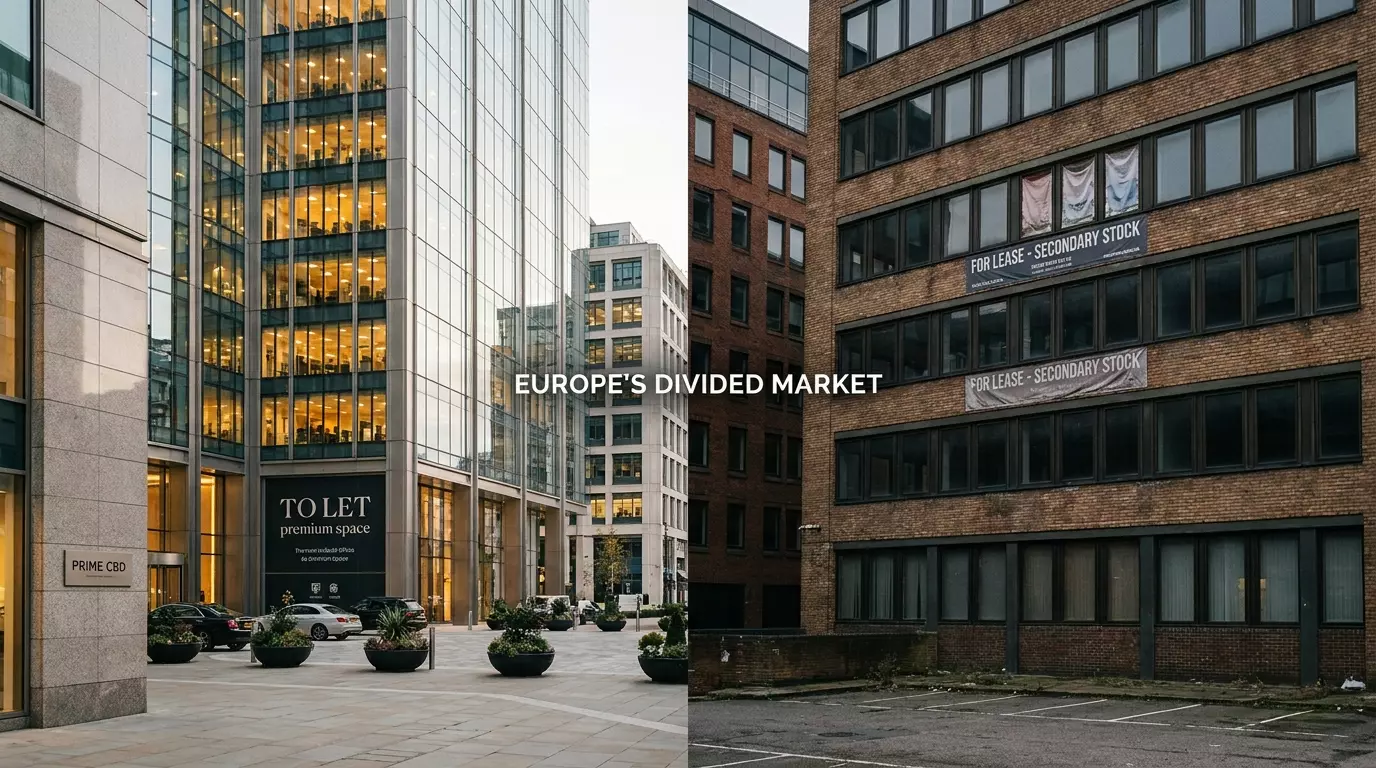
The European office market has entered a defining chapter. Two very different stories are playing out across the continent’s major cities. On one side, premium office buildings in central business districts are thriving with low vacancy rates and climbing rents. On the other side, secondary office stock is struggling under the weight of rising emptiness and tenant departures. This split, commonly referred to as “bifurcation,” is no longer a prediction or a trend to watch. It is the reality shaping investment decisions, development pipelines, and corporate real estate strategies across Europe in 2026. Understanding where the market stands today and where it is heading requires a close look at both sides of this widening gap, as well as the powerful “flight to quality” phenomenon driving it all.
Europe’s Office Bifurcation Is Now Undeniable
For years, analysts warned that the European office sector would eventually fracture into winners and losers. That fracture is now fully visible. According to research from CBRE, prime office vacancy rates in major European cities hover between 3% and 6%, while secondary and peripheral office stock in those same cities often exceeds 15% vacancy. Cities like Paris, Munich, and London tell this story most clearly. The La Défense district in Paris, for example, faces very different dynamics than the city’s core arrondissements, where Grade A space remains fiercely competitive.
What makes this bifurcation so significant is its structural nature. This is not a temporary mismatch caused by a single economic cycle. Instead, it reflects a permanent shift in how companies think about office space. Remote and hybrid work models have reduced the total square footage companies need, but they have simultaneously raised expectations for the quality of the space they do occupy. The result is a market where the best buildings attract multiple competing tenants while older, less well-located properties sit empty for quarters on end. The gap between these two realities continues to widen, and few market observers expect it to narrow anytime soon.
Prime CBD Assets Keep Winning the Rent Race
Prime CBD office assets across Europe are experiencing what can only be described as a landlord’s market. In London’s West End, prime rents reached record levels in late 2025 and have continued climbing into 2026, with top-quality space commanding north of £140 per square foot annually. Similar patterns are visible in cities like Milan, where the Porta Nuova district sees rents rising by 5% to 8% year over year, and in Amsterdam’s Zuidas, where new-build office towers are fully pre-leased before construction wraps up.
Several factors explain why prime assets keep outperforming:
- Limited new supply: Construction costs and planning restrictions have slowed the delivery of new Grade A office buildings across many European markets.
- ESG compliance: Tenants increasingly require buildings that meet stringent sustainability certifications like BREEAM Excellent or LEED Platinum, and only prime stock typically qualifies.
- Talent attraction: Companies view high-quality offices as essential tools for recruiting and retaining employees who now have the option to work from home.
- Amenity expectations: Modern tenants demand on-site wellness facilities, rooftop terraces, cycling infrastructure, and hospitality-grade lobbies.
This combination of constrained supply and elevated demand creates a pricing environment where landlords of the best buildings hold significant negotiating power. Rent-free periods are shrinking, and incentive packages are becoming less generous compared to what tenants could secure in 2022 or 2023.
Secondary Offices Face a Mounting Vacancy Crisis
The picture for secondary office stock is starkly different. Buildings constructed in the 1980s and 1990s, particularly those located outside core business districts, are experiencing vacancy rates that in some markets exceed 20%. Data from JLL shows that secondary office vacancy in cities like Frankfurt, Brussels, and Madrid has reached levels not seen since the aftermath of the 2008 financial crisis. In some suburban office parks, entire floors remain dark with no prospective tenants in the pipeline.
The challenges facing secondary offices are multifaceted and, in many cases, self-reinforcing:
- Obsolescence risk: Older buildings often lack the floor plates, ceiling heights, and mechanical systems needed to meet modern tenant requirements.
- Energy performance gaps: With the EU’s Energy Performance of Buildings Directive tightening requirements, many secondary assets face the prospect of becoming unlettable without major capital expenditure.
- Conversion complexity: While residential or mixed-use conversion is frequently discussed as a solution, the actual economics of converting office buildings remain challenging due to structural constraints, planning hurdles, and high construction costs.
- Negative sentiment loop: As vacancy rises in a building, remaining tenants become less inclined to renew, accelerating the decline.
Some secondary assets will eventually find new life through deep refurbishment or alternative-use conversion. However, a significant portion of Europe’s aging office stock faces the realistic prospect of functional obsolescence, effectively becoming stranded assets on their owners’ balance sheets.
Flight to Quality Reshapes Investor Strategies
The flight to quality is not just a tenant phenomenon. It is fundamentally reshaping how institutional investors approach the European office sector. Major players like Allianz Real Estate, Hines, and Brookfield have concentrated their acquisition and development activity almost exclusively on prime CBD assets over the past 18 months. The logic is straightforward: in a market defined by bifurcation, capital preservation and income growth are only reliably achievable at the top end of the quality spectrum.
This strategic shift is visible in transaction data. According to a Savills report published in early 2026, approximately 70% of European office investment volume in the prior 12 months was directed toward prime or super-prime assets. Yield compression has resumed for the best buildings, with prime office yields in Paris CBD falling below 3.5% and London City prime yields tightening to around 4.25%. Meanwhile, secondary office yields have moved in the opposite direction, widening as investors demand higher risk premiums for assets with uncertain income profiles.
The comparison between these two market segments is striking when viewed side by side:
| Metric | Prime CBD Offices | Secondary Offices |
|---|---|---|
| Vacancy Rate (avg.) | 3% to 6% | 12% to 20%+ |
| Rent Trend | Rising 4% to 8% annually | Flat or declining |
| Yield Direction | Compressing | Widening |
| Tenant Demand | Strong, multiple bids | Weak, extended void periods |
| ESG Compliance | Typically certified | Often non-compliant |
| Capex Requirement | Moderate (maintenance) | High (major refurbishment needed) |
| Investor Appetite | Very strong | Limited and selective |
This table illustrates why capital continues flowing toward prime assets while secondary stock struggles to attract interest at any price point. For investors, the message is clear: quality is not just a preference but a prerequisite for participating in Europe’s office market in 2026.
The flexible office sector adds another dimension to this story. Operators like IWG and newer landlord-operated flex concepts are embedding themselves within prime buildings, offering hospitality-grade services that further elevate the tenant experience. This “Coworking 2.0” model blurs the line between traditional leasing and flexible workspace, giving occupiers the premium environment they demand with the adaptability modern business requires.
In Short
Europe’s office market bifurcation in 2026 is not a passing phase. It is a structural realignment driven by hybrid work patterns, ESG regulations, talent competition, and evolving tenant expectations. Prime CBD assets continue to command rising rents, attract institutional capital, and deliver reliable income. Secondary offices, meanwhile, face a deepening vacancy crisis with limited pathways to recovery outside of significant investment or conversion. For tenants, investors, and developers alike, the flight to quality has become the defining strategy of this era. Those who align with this reality stand to benefit. Those who ignore it risk being left holding assets that the market has moved beyond.
FAQ
What does “bifurcation” mean in the European office market?
Bifurcation refers to the growing divide between high-performing prime office buildings, which enjoy low vacancy and rising rents, and underperforming secondary office stock, which suffers from high vacancy and declining demand.
Why are prime CBD office rents rising in 2026?
Prime rents are rising due to limited new supply of Grade A buildings, strong tenant demand driven by ESG requirements and talent attraction strategies, and a general flight to quality across European markets.
What is driving the flight to quality in European offices?
Key drivers include hybrid work reducing total space needs while raising quality expectations, tightening ESG regulations making older buildings less attractive, and corporate priorities around employee wellbeing and recruitment.
Can secondary office buildings be converted to other uses?
Some secondary offices can be converted to residential, hospitality, or mixed-use properties. However, conversion is often economically challenging due to structural limitations, planning restrictions, and high refurbishment costs.
How are flexible office operators adapting to the bifurcation trend?
Flexible office operators are increasingly partnering with landlords of prime buildings to offer hospitality-grade, amenity-rich workspaces. This “Coworking 2.0” model integrates seamlessly into top-tier assets, reinforcing the flight to quality.


Join The Discussion