

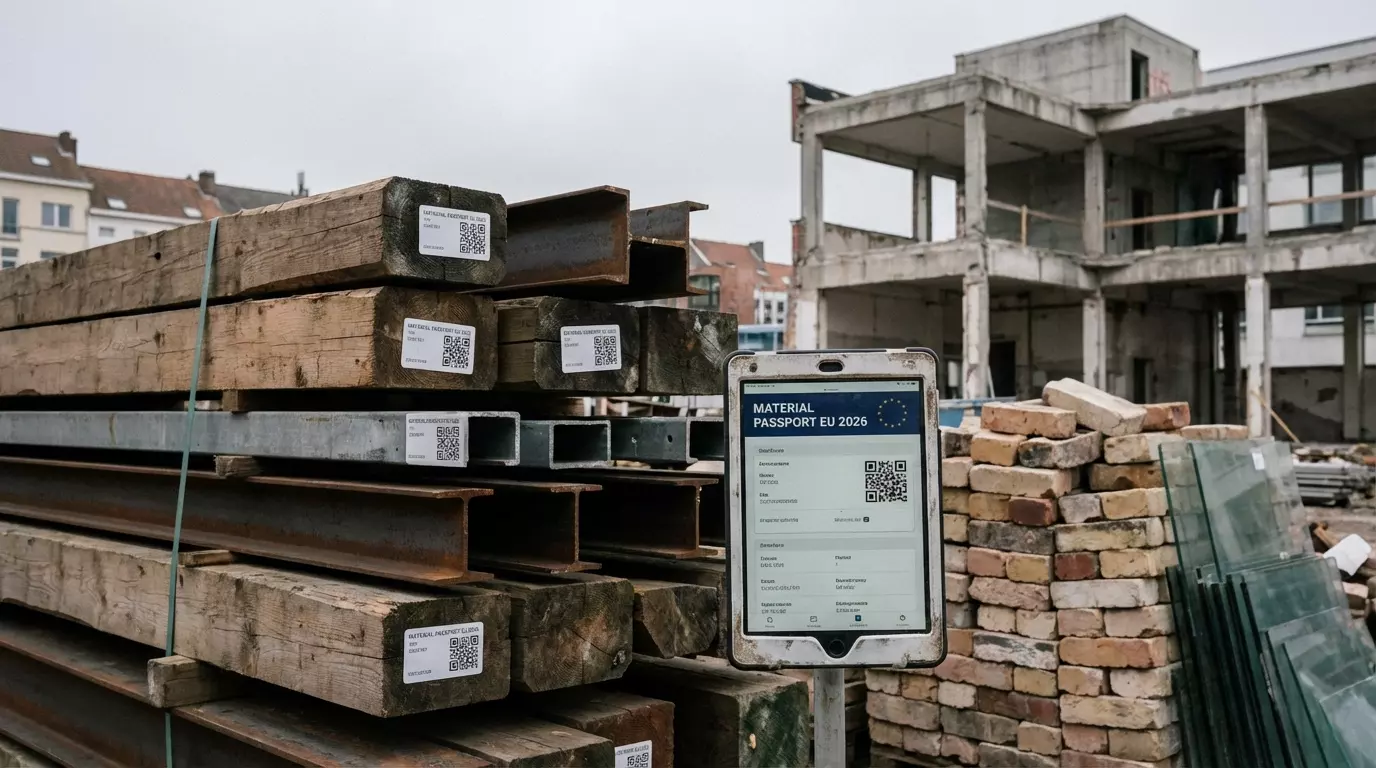
The Circular Economy in Construction: Trends for 2026
The construction industry has long been one of the most resource-hungry sectors on the planet. In Europe alone, buildings and infrastructure account for roughly 50% of all extracted materials and generate about 35% of total waste. But 2026 is shaping up to be a pivotal year. Circular economy principles are no longer a fringe concept discussed at sustainability conferences. They are becoming embedded in regulations, business models, and day-to-day operations across the European construction landscape.
The shift is driven by a simple but powerful idea: stop treating buildings as disposable and start treating them as material banks. By reusing, recycling, and repurposing construction materials, the industry can dramatically lower its carbon footprint while also reducing costs and dependency on virgin resources. From urban mining to material passports, the tools and strategies making this possible are maturing fast. And with the EU Taxonomy for sustainable activities now providing a clear financial framework, the incentives to go circular have never been stronger.
This article explores the key circular economy trends reshaping European construction in 2026, how they work in practice, and why they matter for the future of sustainable building.
How Urban Mining Is Changing Construction in 2026
Urban mining, the practice of recovering valuable materials from existing buildings, infrastructure, and demolition waste, is quickly becoming a cornerstone of circular construction across Europe. Rather than sourcing new steel, concrete, timber, or copper from traditional extraction, forward-thinking developers and contractors are turning to the built environment itself as a resource. In cities like Amsterdam, Brussels, and Copenhagen, pilot projects from previous years have scaled into standard practice. According to the European Environment Agency, construction and demolition waste represents the largest single waste stream in the EU by weight, making it a massive untapped resource.
What makes 2026 different from earlier years is the sophistication of urban mining operations. Companies are now using AI-powered sorting technologies and advanced scanning tools to identify and extract reusable components before demolition even begins. Pre-demolition audits have become common, mapping out which structural steel beams, facade elements, or interior fittings can be salvaged. Firms like Madaster are helping quantify the material value locked inside buildings, giving developers a financial incentive to recover rather than demolish. In the Netherlands, entire neighborhoods are being designed with disassembly in mind, ensuring that today’s new builds become tomorrow’s material banks. The result is a measurable reduction in embodied carbon and a growing secondary materials market that is gaining trust among specifiers and engineers.
Material Passports Are Tracking Every Building Part
One of the most transformative tools enabling the circular economy in construction is the material passport. Think of it as a digital identity card for every component in a building. A material passport records what a product is made of, where it came from, how it was manufactured, and how it can be reused or recycled at end of life. In 2026, adoption across Europe is accelerating, driven by both regulatory pressure and practical benefits. Countries like Luxembourg, Germany, and the Netherlands are leading the way, with several municipalities now requiring material passports for publicly funded construction projects.
The technology behind material passports has matured significantly. Platforms such as Madaster and EPEA (Environmental Protection Encouragement Agency) are providing standardized digital frameworks that integrate with Building Information Modeling (BIM) software. This means architects, contractors, and facility managers can access detailed material data throughout a building’s entire lifecycle. Here is what a typical material passport tracks:
- Material composition: exact substances and chemicals used
- Origin and manufacturer: supply chain transparency
- Structural performance data: load-bearing capacity, fire resistance
- Recyclability score: potential for reuse or recycling
- Toxicity assessment: presence of hazardous substances
- Residual value: estimated economic value at end of life
This level of detail is a game changer. It transforms demolition from a destructive process into a carefully planned harvesting operation. It also gives investors and lenders confidence that circular buildings retain material value over time, which is increasingly relevant under green finance frameworks.
Reusing Materials to Slash Carbon in New Builds
The carbon case for material reuse is compelling and well documented. Manufacturing new construction materials, especially steel, cement, and aluminum, is enormously energy-intensive. Cement production alone accounts for approximately 8% of global CO2 emissions. By contrast, reusing structural steel can reduce associated carbon emissions by up to 97% compared to producing new steel from ore. In 2026, European developers are leveraging these savings not just for environmental credentials but also for compliance with tightening carbon regulations and for competitive advantage in green procurement processes.
Practical examples are multiplying across the continent. In Denmark, the Realdania foundation has supported multiple projects that incorporate reclaimed materials into new residential and commercial buildings. In the UK, contractors are increasingly sourcing reclaimed bricks, timber, and steel through dedicated online marketplaces. The following table illustrates the carbon savings potential of common reused materials compared to their virgin equivalents:
| Material | Carbon Footprint (Virgin) | Carbon Footprint (Reused) | Approximate Savings |
|---|---|---|---|
| Structural Steel | 1.55 kg CO2e/kg | 0.05 kg CO2e/kg | Up to 97% |
| Concrete (crushed aggregate) | 0.13 kg CO2e/kg | 0.05 kg CO2e/kg | Up to 62% |
| Reclaimed Timber | 0.46 kg CO2e/kg | 0.02 kg CO2e/kg | Up to 96% |
| Reclaimed Bricks | 0.22 kg CO2e/kg | 0.03 kg CO2e/kg | Up to 86% |
These numbers are driving a fundamental shift in procurement strategies. Specifiers and architects are increasingly asking not “what new material should we use?” but “what existing material can we reuse?” This mindset change, supported by better data from material passports and urban mining audits, is making low-carbon construction achievable at scale.
EU Taxonomy Pushes Circular Goals Even Further
The EU Taxonomy for sustainable activities has become one of the most influential regulatory tools shaping the circular construction economy. By defining what qualifies as an environmentally sustainable economic activity, the taxonomy gives banks, investors, and asset managers a clear framework for directing capital toward genuinely green projects. In 2026, the taxonomy’s criteria for construction and real estate increasingly reward circular practices. Buildings that demonstrate high levels of material reuse, incorporate material passports, or are designed for disassembly score better under the taxonomy’s technical screening criteria. This directly affects access to green bonds, sustainability-linked loans, and favorable insurance terms.
The alignment between circular economy principles and the EU Taxonomy is creating a powerful feedback loop. Developers who invest in urban mining, material tracking, and design for disassembly are not just reducing environmental impact. They are also improving their financial standing. Key ways the EU Taxonomy supports circular construction include:
- Climate change mitigation: rewarding projects that lower embodied carbon through material reuse
- Transition to a circular economy: explicitly recognizing design for disassembly and material recovery
- Pollution prevention: favoring projects that eliminate hazardous substances, tracked via material passports
- Do no significant harm (DNSH) criteria: ensuring circular strategies do not negatively impact other environmental objectives
This regulatory clarity is helping to mainstream circular construction. It removes ambiguity for investors and provides a common language for sustainability across borders. As more European countries integrate the taxonomy into national building codes and public procurement rules, the business case for circular construction becomes not just attractive but essential.
In Short
The circular economy in construction is no longer a future aspiration. In 2026, it is a practical, measurable, and financially viable reality across Europe. Urban mining is turning demolition waste into valuable resources. Material passports are providing the data transparency needed to make reuse possible at scale. The carbon savings from reusing materials are substantial and well proven. And the EU Taxonomy is providing the financial and regulatory framework to accelerate adoption even further.
For developers, contractors, architects, and investors, the message is clear: circular construction is where the industry is heading. Those who embrace these principles now will be better positioned for tightening regulations, shifting market expectations, and the growing demand for genuinely sustainable buildings. The buildings of 2026 are not just being constructed. They are being designed as the material banks of the future.
FAQ
What is urban mining in construction?
Urban mining refers to the process of recovering and reusing valuable materials from existing buildings, infrastructure, and construction waste rather than sourcing new raw materials from traditional extraction.
How do material passports work?
Material passports are digital records that document the composition, origin, performance characteristics, recyclability, and residual value of every component in a building, enabling efficient reuse and recycling at end of life.
Why does the EU Taxonomy matter for circular construction?
The EU Taxonomy defines what counts as an environmentally sustainable activity, influencing how banks and investors allocate capital. Projects that incorporate circular practices like material reuse and design for disassembly are more likely to qualify for green financing.
How much carbon can be saved by reusing construction materials?
Carbon savings vary by material but can be significant. Reusing structural steel can reduce associated emissions by up to 97%, while reclaimed timber can achieve savings of approximately 96% compared to virgin alternatives.
Is circular construction more expensive than traditional building methods?
Initial costs can sometimes be higher due to additional auditing and logistics, but savings from reduced material procurement, lower waste disposal fees, and access to green financing often make circular approaches cost-competitive or even cheaper over a building’s lifecycle.

Join The Discussion