

The 2026 Finance Bills: New Tax Rules Impacting European Real Estate
Investing in Data Centers 2026: The Race for Power and the Rise of Secondary Hubs
The European data center market stands at a critical inflection point as artificial intelligence workloads transform infrastructure requirements across the continent. Traditional powerhouse markets that once dominated the landscape now face unprecedented challenges, while emerging cities position themselves as the next generation of digital infrastructure hubs. This shift represents not just a geographical redistribution of investment capital but a fundamental reimagining of how data center capacity must be planned and deployed in an AI-driven world.
The convergence of exponential AI demand and finite power resources has created a perfect storm that is reshaping investment strategies across Europe. Institutional investors, hyperscalers, and colocation providers are all scrambling to secure not just land and buildings, but the increasingly precious commodity that powers these facilities: electricity. Understanding this dynamic has become essential for anyone looking to capitalize on the continued digitalization of the European economy.
AI Workloads Push Data Centers Beyond FLAP Markets
The explosive growth of artificial intelligence applications has fundamentally altered the calculus for data center development and investment. Unlike traditional computing workloads, AI processing requires significantly higher power densities and sustained energy consumption. Training large language models and running inference engines demand infrastructure that can deliver consistent, high-capacity power to individual server racks. This reality has exposed the limitations of Europe’s historically dominant FLAP markets (Frankfurt, London, Amsterdam, and Paris), which built their reputations during an era of more modest power requirements.
Cushman & Wakefield research indicates that AI-driven demand is accelerating data center absorption rates far beyond previous forecasts. The power required per rack has increased from an average of 5-8 kilowatts just a few years ago to 30-50 kilowatts for AI-optimized facilities, with some specialized deployments requiring even more. This dramatic escalation means that existing infrastructure in established markets simply cannot accommodate the next wave of capacity expansion. Developers who secured sites in FLAP markets years ago now find themselves power-constrained, unable to build out their planned facilities to full capacity despite having construction-ready land and planning permissions in place.
Power Constraints Force Investors to Secondary Hubs
The power crisis in primary European data center markets has moved from a theoretical concern to an immediate operational reality. Frankfurt, once Europe’s undisputed data center capital, has implemented increasingly strict limitations on new high-power connections. Grid operators in Amsterdam have effectively halted new large-scale data center developments in certain areas due to insufficient electrical infrastructure. London faces similar challenges, with available power capacity in key data center zones either fully committed or prohibitively expensive. Paris continues to attract investment but at a pace constrained by the time required to upgrade electrical distribution networks.
These limitations have created a ripple effect throughout the investment community. Pension funds, sovereign wealth funds, and private equity firms that allocated billions to European data center strategies now face difficult choices. Projects that looked viable on paper encounter multi-year delays waiting for power infrastructure upgrades, if such upgrades prove feasible at all. According to industry analysis, some investors have written down the value of land holdings in constrained markets, acknowledging that without adequate power supply, even prime locations lose their strategic value. This realization has accelerated capital redeployment toward markets where power availability, rather than historical market dominance, drives site selection decisions.
Berlin, Milan, and Warsaw Emerge as Viable Alternatives
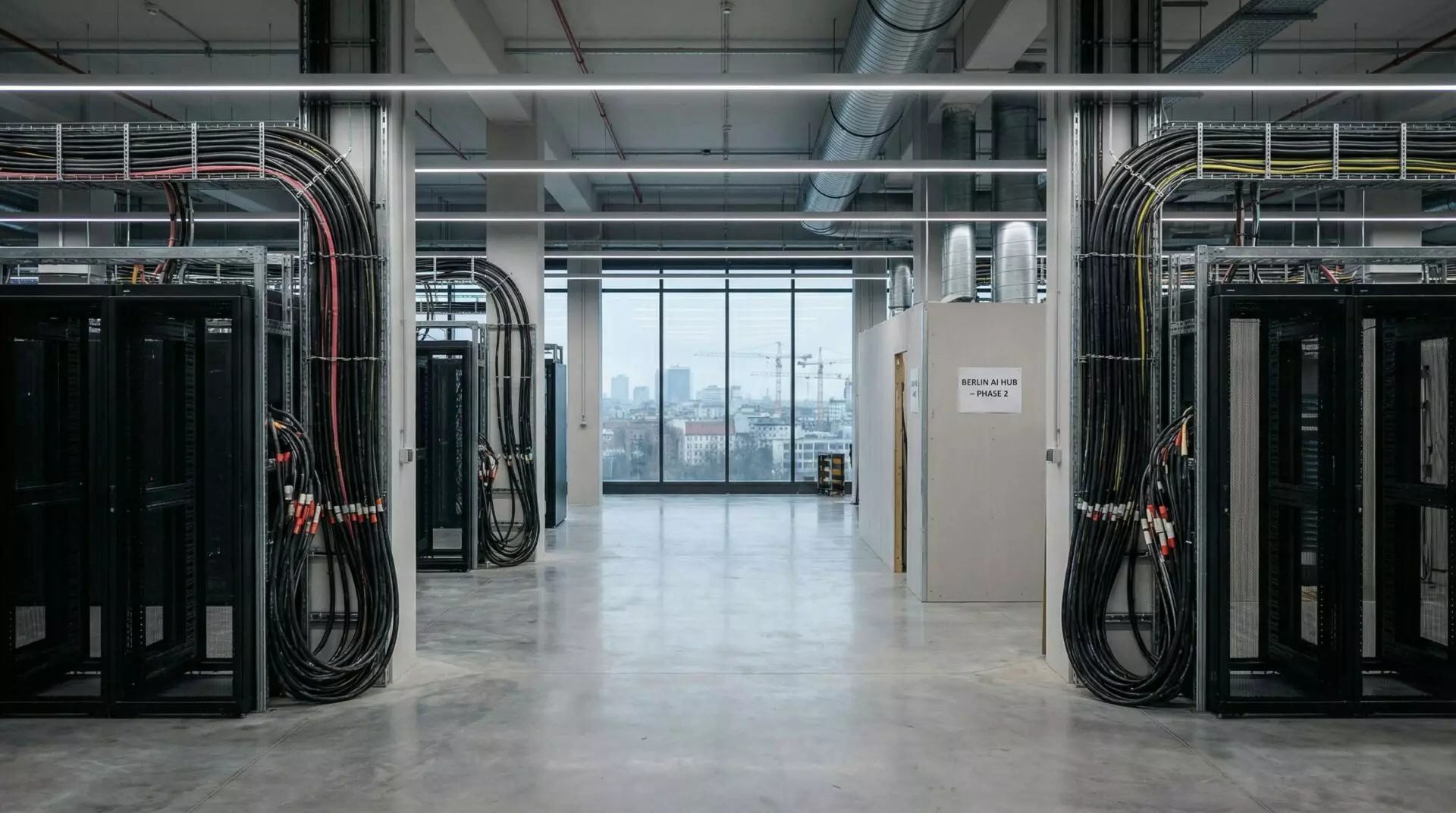
Berlin has positioned itself as a compelling alternative to Frankfurt, offering a combination of available power capacity, strong connectivity infrastructure, and proximity to major European markets. The German capital benefits from ongoing investments in renewable energy infrastructure and a municipal government actively courting data center investment as part of its economic development strategy. Power costs remain competitive compared to constrained FLAP markets, and the availability of large industrial sites suitable for campus-style data center development provides flexibility for hyperscale deployments. Several major operators have announced significant Berlin projects in the past 18 months, validating the market’s emergence as a serious alternative.
Milan represents Southern Europe’s answer to the capacity crunch, with Italy’s financial capital leveraging its position as a connectivity crossroads between Northern Europe and the Mediterranean. The city offers access to diverse power sources, including hydroelectric capacity from Alpine regions, and has streamlined permitting processes to attract data center investment. Warsaw, meanwhile, has become Central Europe’s dark horse candidate, combining lower land and construction costs with improving fiber connectivity to Western European markets. Polish authorities have prioritized data center development as part of broader technology sector initiatives, offering incentives that make the total cost of ownership attractive compared to traditional markets. These three cities share a common advantage: available electrical grid capacity that can support the power-hungry AI workloads driving current demand.
How Energy Availability Reshapes European DC Strategy
The shift toward power-first site selection represents a fundamental change in how data center investment decisions are made. Historically, connectivity, network latency, and proximity to end users topped the criteria list. While these factors remain important, they have been joined, and in some cases superseded, by a more basic question: can the site access sufficient power, and at what cost? This reorientation has led to sophisticated modeling of not just current electrical capacity but projected grid developments over 10-15 year time horizons. Investors now conduct due diligence on regional energy policy, utility capital expenditure plans, and renewable energy project pipelines with the same rigor previously reserved for market demand analysis.
Energy availability has also influenced facility design and operational strategies. Developers in secondary markets are building facilities with greater power density capabilities from the outset, even if initial tenant requirements do not demand maximum capacity. This future-proofing approach ensures that facilities can accommodate AI workloads as they migrate from primary to secondary markets. Some operators are exploring on-site power generation, including natural gas generators and even small-scale nuclear solutions, to supplement grid power and provide resilience against supply constraints. The economics of these approaches vary significantly by market, but the willingness to consider them reflects how central energy security has become to data center strategy. According to recent market surveys, over 60% of data center investors now cite power availability as their primary site selection criterion, a dramatic increase from just 30% three years ago.
In Short
The European data center landscape is undergoing its most significant transformation in decades, driven by the collision of AI-driven demand growth and power infrastructure limitations. The FLAP markets that defined the industry’s first generation now face constraints that have opened opportunities for Berlin, Milan, Warsaw, and other emerging hubs. This redistribution of investment capital reflects a maturation of the market, where fundamental infrastructure capabilities matter more than historical precedent.
For investors, the message is clear: success in European data centers through 2026 and beyond requires a power-first strategy. Those who can secure reliable, cost-effective electrical supply will capture the value creation opportunity presented by AI workloads. Those who remain anchored to traditional markets without adequate power solutions risk being left behind. The race is on, and energy availability has become the ultimate competitive advantage in Europe’s evolving data center ecosystem.
FAQ
What are FLAP markets in data centers?
FLAP is an acronym for Frankfurt, London, Amsterdam, and Paris, the four traditional hub cities that have dominated European data center investment and development for the past two decades due to their connectivity, financial importance, and established infrastructure.
Why do AI workloads require more power than traditional computing?
AI workloads, particularly training large language models and running inference engines, require significantly higher computational power per server, translating to 30-50 kilowatts per rack compared to 5-8 kilowatts for traditional applications, creating much greater electrical demand.
Are secondary markets like Berlin less connected than FLAP cities?
While FLAP markets have historically offered superior connectivity, secondary hubs like Berlin, Milan, and Warsaw have invested heavily in fiber infrastructure and now provide adequate connectivity for most applications, with latency differences becoming less significant for many workloads.
How long does it take to upgrade power infrastructure for data centers?
Power infrastructure upgrades typically require 3-7 years from planning to completion, depending on the scope and regulatory environment, which explains why constrained markets cannot quickly solve their capacity limitations.
Will FLAP markets become irrelevant for data centers?
FLAP markets will remain important but will likely serve different roles, focusing on low-latency applications and network interconnection while secondary markets absorb capacity-intensive AI workloads that require abundant power.
What role do renewable energy sources play in secondary market advantages?
Many secondary markets have better access to renewable energy sources, particularly hydroelectric and wind power, which provides both cost advantages and helps data center operators meet sustainability commitments increasingly demanded by enterprise customers.

Join The Discussion